


Page 16 - ArithBook5thEd ~ BCC
P. 16
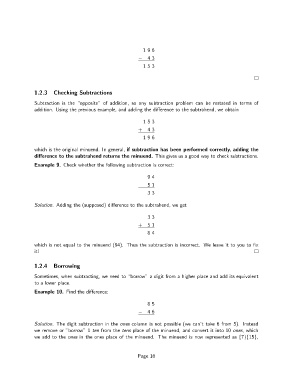
196
                                                           − 43

                                                             153


               1.2.3   Checking Subtractions
               Subtraction is the “opposite” of addition, so any subtraction problem can be restated in terms of
               addition. Using the previous example, and adding the difference to the subtrahend, we obtain

                                                             153
                                                           +4 3
                                                             196

               which is the original minuend. In general, if subtraction has been performed correctly, adding the
               difference to the subtrahend returns the minuend. This gives us a good way to check subtractions.
               Example 9. Check whether the following subtraction is correct:


                                                               94
                                                           − 51
                                                               33

               Solution. Adding the (supposed) difference to the subtrahend, we get

                                                               33
                                                           +5 1
                                                               84

               which is not equal to the minuend (94). Thus the subtraction is incorrect. We leave it to you to fix
               it!


               1.2.4   Borrowing
               Sometimes, when subtracting, we need to “borrow” a digit from a higher place and add its equivalent
               to a lower place.
               Example 10. Find the difference:


                                                               85
                                                           − 46

               Solution. The digit subtraction in the ones column is not possible (we can’t take 6 from 5). Instead
               we remove or ”borrow” 1 ten from the tens place of the minuend, and convert it into 10 ones,which
               we add to the ones in the ones place of the minuend. The minuend is now represented as {7}{15},


                                                           Page 16

