


Page 20 - ArithBook5thEd ~ BCC
P. 20
1.3     Multiplying Whole Numbers


               Multiplication is really just repeated addition. When we say “4times 3equals 12,” we can think of it
               as starting at 0 and adding 3 four times over:


                                                   0+ 3+ 3 + 3+ 3 = 12.

               We can leave out the 0, since 0 is the additive identity ( 0+3 = 3). Using the symbol × for multiplication,
               we write
                                                 3+ 3 + 3+ 3 = 4 × 3= 12.

               The result of multiplying two or more numbers is called the product of the numbers. Instead of the ×
               symbol, we often use a central dot (·) to indicate a product. Thus, for example, instead of 2 × 4= 8,
               we can write

                                                          2 · 4= 8.
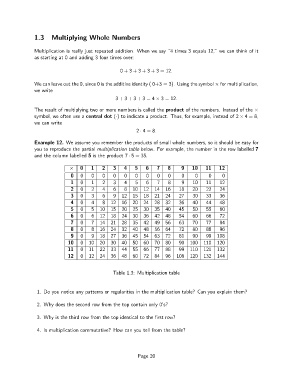
               Example 12. We assume you remember the products of small whole numbers, so it should be easy for
               you to reproduce the partial multiplication table below. For example, the number in the row labelled 7
               and the column labelled 5 is the product 7 · 5= 35.


                              ×    0   1    2   3    4   5    6    7   8     9   10    11    12
                               0   0   0    0   0    0    0   0    0   0     0     0    0     0
                               1   0   1    2   3    4    5   6    7   8     9   10    11    12
                               2   0   2    4   6    8  10   12   14  16    18   20    22    24
                               3   0   3    6   9   12  15   18   21  24    27   30    33    36
                               4   0   4    8  12   16  20   24   28  32    36   40    44    48
                               5   0   5   10  15   20  25   30   35  40    45   50    55    60
                               6   0   6   12  18   24  30   36   42  48    54   60    66    72
                               7   0   7   14  21   28  35   42   49  56    63   70    77    84
                               8   0   8   16  24   32  40   48   56  64    72   80    88    96
                               9   0   9   18  27   36  45   54   63  72    81   90    99   108
                             10    0  10   20  30   40  50   60   70  80    90  100   110   120
                             11    0  11   22  33   44  55   66   77  88    99  110   121   132
                             12    0  12   24  36   48  60   72   84  96   108  120   132   144


                                                Table 1.3: Multiplication table


                1. Do you notice any patterns or regularities in the multiplication table? Can you explain them?


                2. Why does the second row from the top contain only 0’s?

                3. Why is the third row from the top identical to the first row?

                4. Is multiplication commutative? How can you tell from the table?


                                                           Page 20

