


Page 152 - ArithBook5thEd ~ BCC
P. 152
5.2     Proportions

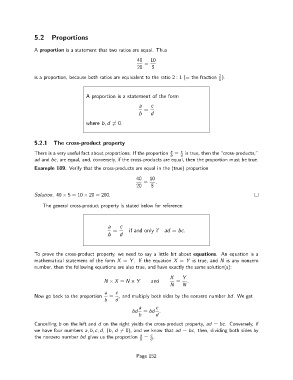
               A proportion is a statement that two ratios are equal. Thus

                                                          40    10
                                                             =
                                                          20    5
                                                                                             2
               is a proportion, because both ratios are equivalent to the ratio 2 : 1 (= the fraction ).
                                                                                             1

                                     Aproportion is a statement of the form

                                                           a    c
                                                             =
                                                           b    d
                                     where b, d ̸=0.


               5.2.1   The cross-product property
               There is a very useful fact about proportions: If the proportion  a  =  c  is true, then the “cross-products,”
                                                                        b   d
               ad and bc, are equal, and, conversely, if the cross-products are equal, then the proportion must be true.
               Example 189. Verify that the cross-products are equal in the (true) proportion

                                                          40    10
                                                             =    .
                                                          20    5
               Solution. 40 × 5= 10 × 20 = 200.

                   The general cross-product property is stated below for reference:


                                              a    c
                                                =      if and only if ad = bc.
                                              b    d


               To prove the cross-product property, we need to say a little bit about equations.An equation is a
               mathematical statement of the form X = Y .If the equation X = Y is true, and N is any nonzero
               number, then the following equations are also true, and have exactly the same solution(s):

                                                                        X    Y
                                             N × X = N × Y      and        =   .
                                                                        N    N
                                             a   c
               Now go back to the proportion   =   , and multiply both sides by the nonzero number bd.We get
                                             b   d
                                                           a      c
                                                        bd   = bd .
                                                           b      d
               Cancelling b on the left and d on the right yields the cross-product property, ad = bc. Conversely, if
               we have four numbers a, b, c, d,(b, d ̸=0), and we know that ad = bc,then,dividing both sides by
                                                                c
               the nonzero number bd gives us the proportion  a  = .
                                                            b   d

                                                          Page 152

