


Page 155 - ArithBook5thEd ~ BCC
P. 155
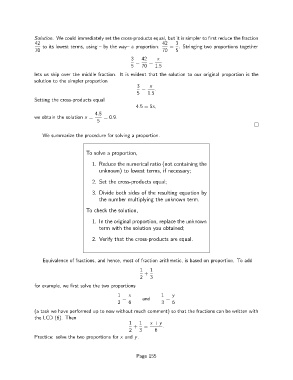
Solution. We could immediately set the cross-products equal, but it is simpler to first reduce the fraction
                42                                                   42   3
                   to its lowest terms, using – by the way– a proportion:  = . Stringing two proportions together
                70                                                   70   5
                                                        3   42     x
                                                          =    =
                                                        5   70    1.5
               lets us skip over the middle fraction. It is evident that the solution to our original proportion is the
               solution to the simpler proportion
                                                          3     x
                                                            =     .
                                                          5    1.5
               Setting the cross-products equal
                                                          4.5 = 5x,
                                         4.5
               we obtain the solution x =   =0.9.
                                          5


                   We summarize the procedure for solving a proportion.


                                     To solve a proportion,

                                        1. Reduce the numerical ratio (not containing the
                                          unknown) to lowest terms, if necessary;

                                        2. Set the cross-products equal;

                                        3. Divide both sides of the resulting equation by
                                          the number multiplying the unknown term.

                                     To check the solution,

                                        1. In the original proportion, replace the unknown
                                          term with the solution you obtained;

                                        2. Verify that the cross-products are equal.


                   Equivalence of fractions, and hence, most of fraction arithmetic, is based on proportion. To add

                                                            1   1
                                                             +
                                                            2   3
               for example, we first solve the two proportions
                                                  1    x            1    y
                                                    =        and      =
                                                  2    6            3    6
               (a task we have performed up to now without much comment) so that the fractions can be written with
               the LCD (6). Then
                                                       1   1    x + y
                                                         +   =       .
                                                       2   3      6
               Practice: solve the two proportions for x and y.


                                                          Page 155

