


Page 157 - ArithBook5thEd ~ BCC
P. 157
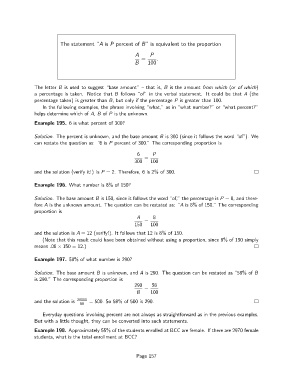
The statement “A is P percent of B”is equivalent tothe proportion

                                                          A     P
                                                            =      .
                                                         B     100


               The letter B is used to suggest “base amount” – that is, B is the amount from which (or of which)
               a percentage is taken. Notice that B follows “of” in the verbal statement. It could be that A (the
               percentage taken) is greater than B, but only if the percentage P is greater than 100.
                   In the following examples, the phrase involving “what,” as in “what number?” or “what percent?”
               helps determine which of A, B of P is the unknown.

               Example 195. 6 is what percent of 300?

               Solution. The percent is unknown, and the base amount B is 300 (since it follows the word “of”). We
               can restate the question as: “6 is P percent of 300.” The corresponding proportion is

                                                          6      P
                                                             =
                                                         300    100
               and the solution (verify it!) is P = 2. Therefore, 6 is 2% of 300.


               Example 196. What number is 8% of 150?

               Solution. The base amount B is 150, since it follows the word “of,” the percentage is P = 8, and there-
               fore A is the unknown amount. The question can be restated as: “A is 8% of 150.” The corresponding
               proportion is
                                                          A      8
                                                             =
                                                         150    100
               and the solution is A = 12 (verify!). It follows that 12 is 8% of 150.
                   (Note that this result could have been obtained without using a proportion, since 8% of 150 simply
               means .08 × 150 = 12.)

               Example 197. 58% of what number is 290?

               Solution. The base amount B is unknown, and A is 290. The question can be restated as “58% of B
               is 290.” The corresponding proportion is
                                                         290    58
                                                             =
                                                          B     100
               and the solution is  29000  =500. So 58% of 500 is 290.
                                  58
                   Everyday questions involving percent are not always as straightforward as in the previous examples.
               But with a little thought, they can be converted into such statements.

               Example 198. Approximately 55% of the students enrolled at BCC are female. If there are 2970 female
               students, what is the total enrollment at BCC?


                                                          Page 157

