


Page 153 - ArithBook5thEd ~ BCC
P. 153
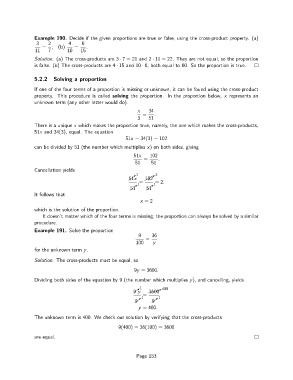
Example 190. Decide if the given proportions are true or false, using the cross-product property. (a)
                3    2        4    6
                   = ;   (b)    =    .
                11   7       10    15
               Solution. (a) The cross-products are 3 · 7= 21 and 2 · 11 = 22. They are not equal, so the proportion
               is false. (b) The cross-products are 4 · 15 and 10 · 6, both equal to 60. So the proportion is true.


               5.2.2   Solving a proportion

               If one of the four terms of a proportion is missing or unknown, it can be found using the cross-product
               property. This procedure is called solving the proportion. In the proportion below, x represents an
               unknown term (any other letter would do).
                                                           x   34
                                                             =    .
                                                           3   51
               There is a unique x which makes the proportion true, namely, the one which makes the cross-products,
               51x and 34(3), equal. The equation
                                                     51x =34(3) =102
               can be divided by 51 (the number which multiplies x)on both sides, giving
                                                         51x    102
                                                             =     .
                                                         51     51
               Cancellation yields
                                                               ✟ ✟✯
                                                                  2
                                                        ✚❃
                                                       ✚ 51x 1  =  ✟ 102  =2.
                                                               ✚❃
                                                        ✚❃
                                                       ✚ 51  1  ✚ 51  1
               It follows that
                                                            x =2
               which is the solution of the proportion.
                   It doesn’t matter which of the four terms is missing; the proportion can always be solved by a similar
               procedure.

               Example 191. Solve the proportion
                                                           9    36
                                                              =
                                                          100    y
               for the unknown term y.

               Solution. The cross-products must be equal, so

                                                         9y =3600.
               Dividing both sides of the equation by 9 (the number which multiplies y), and cancelling, yields

                                                                 ✘ ✘✿ 400
                                                         ✚❃
                                                         ✚ 9 y 1  =  ✘ 3600
                                                         ✚ 9 ✚❃ 1  ✚ 9 ✚❃ 1
                                                           y =400.
               The unknown term is 400. We check our solution by verifying that the cross-products

                                                   9(400) = 36(100) = 3600
               are equal.


                                                          Page 153

