


Page 44 - ArithBook5thEd ~ BCC
P. 44
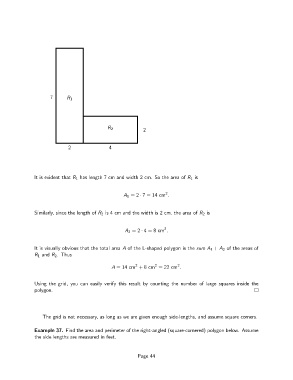
7      R 1


                                              R 2            2


                              2                4


               It is evident that R 1 has length 7 cm and width 2 cm. So the area of R 1 is


                                                                      2
                                                     A 1 =2 · 7= 14 cm .


               Similarly, since the length of R 2 is 4 cm and the width is 2 cm, the area of R 2 is


                                                                      2
                                                     A 2 =2 · 4= 8 cm .


               It is visually obvious that the total area A of the L-shaped polygon is the sum A 1 + A 2 of the areas of
               R 1 and R 2 .Thus

                                                                           2
                                                                  2
                                                          2
                                                A =14 cm +8 cm =22 cm .
               Using the grid, you can easily verify this result by counting the number of large squares inside the
               polygon.


                   The grid is not necessary, as long as we are given enough side-lengths, and assume square corners.


               Example 37. Find the area and perimeter of the right-angled (square-cornered) polygon below. Assume
               the side lengths are measured in feet.


                                                           Page 44

