


Page 45 - ArithBook5thEd ~ BCC
P. 45
5


                                               2

                     6
                                       3


                                                      1

                                      5


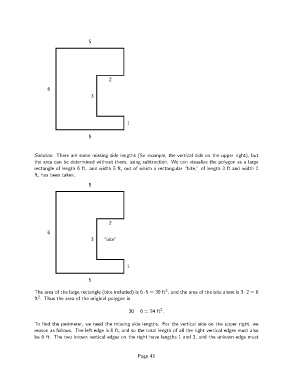
               Solution. There are some missing side lengths (for example, the vertical side on the upper right), but
               the area can be determined without them, using subtraction. We can visualize the polygon as a large
               rectangle of length 6 ft. and width 5 ft, out of which a rectangular “bite,” of length 3 ft and width 2
               ft, has been taken.

                                      5


                                               2
                     6
                                       3    “bite”


                                                      1

                                      5

                                                                      2
               The area of the large rectangle (bite included) is 6·5= 30 ft , and the area of the bite alone is 3·2= 6
                 2
               ft . Thus the area of the original polygon is
                                                                    2
                                                       30 − 6= 24 ft .

               To find the perimeter, we need the missing side lengths. For the vertical side on the upper right, we
               reason as follows. The left edge is 6 ft, and so the total length of all the right vertical edges must also
               be 6 ft. The two known vertical edges on the right have lengths 1 and 3, and the unkown edge must


                                                           Page 45

