


Page 77 - ArithBook5thEd ~ BCC
P. 77
3.3.3   Converting a mixed or whole number to an improper fraction

               Sometimes we need to change a mixed number back into an improper fraction. The key fact, again, is
               that the fraction
                                                              a
                                                              a
               is always equal to 1, for any number a except 0. For example,

                                                           3
                                                             =1.
                                                           3

                                                       1
               Example 82. Convert the mixed number 2 to an improper fraction, using the fact that  3  =1.
                                                       3                                          3
               Solution. Think of the whole number 2 in the following way:

                                                                 3   3
                                                     2= 1 + 1 =    + .
                                                                 3   3
                                                1
               It follows that the mixed number 2 can be written
                                                3
                                                         3   3    1
                                                           +   + .
                                                         3   3    3
                                                                                              7
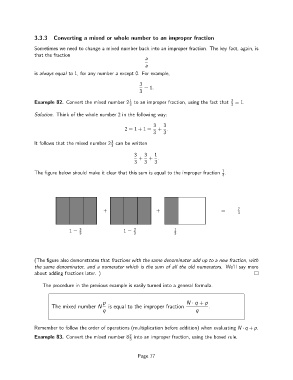
               The figure below should make it clear that this sum is equal to the improper fraction .
                                                                                              3


                                            +                     +                          =      7
                                                                                                    3


                              1=  3                  1=  3                1
                                  3                      3                3


               (The figure also demonstrates that fractions with the same denominator add up to a new fraction, with
               the same denominator, and a numerator which is the sum of all the old numerators. We’ll say more
               about adding fractions later. )

                   The procedure in the previous example is easily turned into a general formula.


                                            p                                  N · q + p
                       The mixed number N     is equal to the improper fraction         .
                                            q                                      q


               Remember to follow the order of operations (multiplication before addition) when evaluating N · q + p.
                                                       2
               Example 83. Convert the mixed number 8 into an improper fraction, using the boxed rule.
                                                       3

                                                           Page 77

