


Page 81 - ArithBook5thEd ~ BCC
P. 81
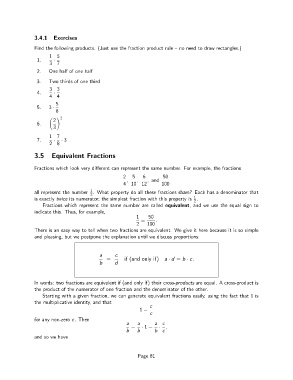
3.4.1   Exercises

               Find the following products. (Just use the fraction product rule – no need to draw rectangles.)
                      1 5
                1.      ·
                      3 7
                2.   One half of one half

                3.   Two thirds of one third
                      3 3
                4.      ·
                      4 4
                        5
                5.   3 ·
                        8

                       2
                     " #  2
                6.
                       3
                      1 7
                7.      ·  · 3
                      2 8

               3.5     Equivalent Fractions

               Fractions which look very different can represent the same number. For example, the fractions
                                                     2  5    6       50
                                                      ,   ,    ,and
                                                     4 10   12       100
                                       1
               all represent the number . What property do all these fractions share? Each has a denominator that
                                       2
                                                                                  1
               is exactly twice its numerator; the simplest fraction with this property is .
                                                                                  2
                   Fractions which represent the same number are called equivalent,and we use the equal sign to
               indicate this. Thus, for example,
                                                          1    50
                                                            =     .
                                                          2   100
               There is an easy way to tell when two fractions are equivalent. We give it here because it is so simple
               and pleasing, but we postpone the explanation until we discuss proportions.


                                           a     c
                                             =       if (and only if) a · d = b · c.
                                           b     d


               In words: two fractions are equivalent if (and only if) their cross-products are equal. A cross-product is
               the product of the numerator of one fraction and the denominator of the other.
                   Starting with a given fraction, we can generate equivalent fractions easily, using the fact that 1 is
               the multiplicative identity, and that
                                                                c
                                                           1=
                                                                c
               for any non-zero c.Then
                                                      a   a       a c
                                                        =   · 1=    · ,
                                                      b   b       b c
               and so we have


                                                           Page 81

