


Page 82 - ArithBook5thEd ~ BCC
P. 82
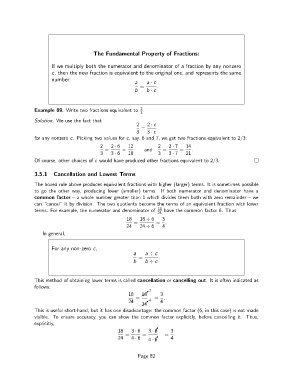
The Fundamental Property of Fractions:


                       If we multiply both the numerator and denominator of a fraction by any nonzero
                       c,then the new fraction is equivalent to the original one, and represents the same
                       number:
                                                         a    a · c
                                                           =       .
                                                         b    b · c


                                                            2
               Example 89. Write two fractions equivalent to .
                                                            3
               Solution. We use the fact that
                                                          2    2 · c
                                                            =
                                                          3    3 · c
               for any nonzero c. Picking two values for c, say, 6 and 7, we get two fractions equivalent to 2/3:

                                           2   2 · 6   12          2    2 · 7  14
                                             =      =        and     =      =    .
                                           3   3 · 6   18          3    3 · 7  21
               Of course, other choices of c would have produced other fractions equivalent to 2/3.


               3.5.1   Cancellation and Lowest Terms

               The boxed rule above produces equivalent fractions with higher (larger) terms. It is sometimes possible
               to go the other way, producing lower (smaller) terms. If both numerator and denominator have a
               common factor – a whole number greater than 1 which divides them both with zero remainder – we
               can “cancel” it by division. The two quotients become the terms of an equivalent fraction with lower
               terms. For example, the numerator and denominator of  18  have the common factor 6. Thus
                                                                   24
                                                      18   18 ÷ 6    3
                                                         =        = .
                                                      24   24 ÷ 6    4
                   In general,


                       For any non-zero c,
                                                         a    a ÷ c
                                                           =       .
                                                         b    b ÷ c


               This method of obtaining lower terms is called cancellation or cancelling out.It is often indicated as
               follows:
                                                             ✚❃
                                                       18   ✚ 18  3  3
                                                          =      =   .
                                                       24    ✚❃ 4   4
                                                            ✚ 24
               This is useful short-hand, but it has one disadvantage: the common factor (6, in this case) is not made
               visible. To ensure accuracy, you can show the common factor explicitly, before cancelling it. Thus,
               explicitly,
                                                  18    3 · 6  3 · ✁ 6 ✁✕  3
                                                     =      =         = .
                                                  24    4 · 6  4 · ✁ 6 ✁✕  4


                                                           Page 82

