


Page 87 - ArithBook5thEd ~ BCC
P. 87
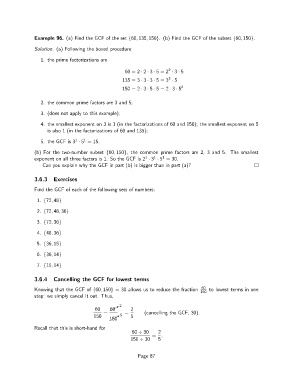
Example 96. (a) Find the GCF of the set {60, 135, 150}.(b) Find the GCF of the subset {60, 150}.

               Solution. (a) Following the boxed procedure:

                  1. the prime factorizations are

                                                                       2
                                                     60 = 2 · 2 · 3 · 5= 2 · 3 · 5
                                                                       3
                                                    135 = 3 · 3 · 3 · 5= 3 · 5
                                                    150 = 2 · 3 · 5 · 5= 2 · 3 · 5 2


                  2. the common prime factors are 3 and 5;

                  3. (does not apply to this example);

                  4. the smallest exponent on 3 is 1 (in the factorizations of 60 and 150); the smallest exponent on 5
                     is also 1 (in the factorizations of 60 and 135);
                                    1
                                1
                  5. the GCF is 3 · 5 =15.
               (b) For the two-number subset {60, 150}, the common prime factors are 2, 3 and 5. The smallest
                                                                     1
                                                                 1
                                                              1
               exponent on all three factors is 1. So the GCF is 2 · 3 · 5 =30.
                   Can you explain why the GCF in part (b) is bigger than in part (a)?
               3.6.3   Exercises

               Find the GCF of each of the following sets of numbers:

                1. {72, 48}

                2. {72, 48, 36}

                3. {72, 36}
                4. {48, 36}

                5. {36, 15}

                6. {36, 14}

                7. {15, 14}

               3.6.4   Cancelling the GCF for lowest terms

               Knowing that the GCF of {60, 150} = 30 allows us to reduce the fraction  60  to lowest terms in one
                                                                                     150
               step: we simply cancel it out. Thus,
                                                 ✟✯ 2
                                         60    ✟ 60     2
                                            =        =       (cancelling the GCF, 30).
                                        150      ✟ ✟✯  5  5
                                               ✟ 150
               Recall that this is short-hand for
                                                        60 ÷ 30    2
                                                                 =  .
                                                        150 ÷ 30   5


                                                           Page 87

