


Page 86 - ArithBook5thEd ~ BCC
P. 86
3.6.1   Exercises

               Find the prime factorizations of the following numbers. Check the results by multiplication.
                1. 60

                2. 48

                3. 81
                4. 360

                5. 85

                6. 154
                7. Which of the numbers above is divisible by 3?


               3.6.2   Finding the GCF

               Using prime factorizations, it is easy to find the greatest common factor of a set of numbers.
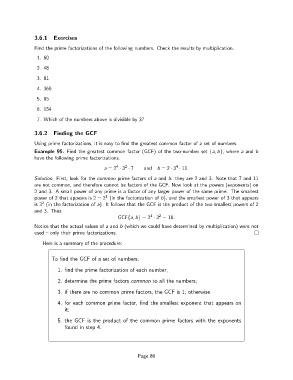
               Example 95. Find the greatest common factor (GCF) of the two-number set {a, b}, where a and b
               have the following prime factorizations.

                                                                           4
                                                  4
                                                     2
                                             a =2 · 3 · 7    and   b =2 · 3 · 11.
               Solution. First, look for the common prime factors of a and b: they are 2 and 3. Note that 7 and 11
               are not common, and therefore cannot be factors of the GCF. Now lookat the powers (exponents) on
               2 and 3. A small power of any prime is a factor of any larger power of the same prime. The smallest
                                             1
               power of 2 that appears is 2 = 2 (in the factorization of b), and the smallest power of 3 that appears
                   2
               is 3 (in the factorization of a). It follows that the GCF is the product of the two smallest powers of 2
               and 3. Thus
                                                                1
                                                                   2
                                                  GCF{a, b} =2 · 3 =18.
               Notice that the actual values of a and b (which we could have determined by multiplication) were not
               used – only their prime factorizations.

                   Here is a summary of the procedure:


                       To find the GCF of a set of numbers:

                         1. find the prime factorization of each number;
                         2. determine the prime factors common to all the numbers;

                         3. if there are no common prime factors, the GCF is 1; otherwise

                         4. for each common prime factor, find the smallest exponent that appears on
                            it;

                         5. the GCF is the product of the common prime factors with the exponents
                            found in step 4.


                                                           Page 86

