


Page 90 - ArithBook5thEd ~ BCC
P. 90
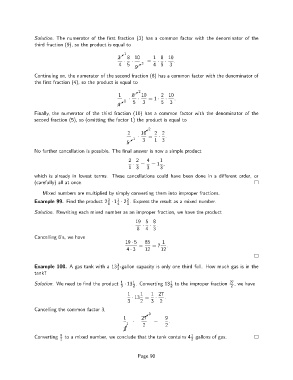
Solution. The numerator of the first fraction (3) has a common factor with thedenominator of the
               third fraction (9), so the product is equal to

                                                  ✚ 3 ✚❃ 1  8 10  1 8 10
                                                     ·  ·      =   ·  ·   .
                                                   4  5   ✚❃ 3   4 5    3
                                                         ✚ 9
               Continuing on, the numerator of the second fraction (8) has a common factor with the denominator of
               the first fraction (4), so the product is equal to

                                                   1    ✚ 8 ✚❃ 2 10  2 10
                                                       ·   ·   =1 ·   ·   .
                                                     1
                                                  ✚ 4 ✚❃  5  3      5   3
               Finally, the numerator of the third fraction (10) has a common factor with the denominator of the
               second fraction (5), so (omitting the factor 1) the product is equal to

                                                             ✚❃
                                                      2     ✚ 10  2  2 2
                                                           ·   =   · .
                                                         1
                                                      ✚ 5 ✚❃  3   1 3
               No further cancellation is possible. The final answer is now a simple product
                                                       2 2    4     1
                                                         ·  =   =1 ,
                                                       1 3    3     3
               which is already in lowest terms. These cancellations could have been done in a different order, or
               (carefully) all at once.

                   Mixed numbers are multiplied by simply converting them into improper fractions.
                                              3
                                                      2
                                                  1
               Example 99. Find the product 2 · 1 · 2 . Express the result as a mixed number.
                                              8   4   3
               Solution. Rewriting each mixed number as an improper fraction, we have the product
                                                          19 5 8
                                                             ·  · .
                                                          8   4 3
               Cancelling 8’s, we have
                                                     19 · 5   85     1
                                                           =     =7    .
                                                      4 · 3   12    12


                                                  1
               Example 100. Agas tank with a 13 -gallon capacity is only one third full. How much gas is in the
                                                  2
               tank?
                                                         1
                                                                        1
               Solution. We need to find the product  1  · 13 . Converting 13 to the improper fraction  27  ,we have
                                                                                                 2
                                                                        2
                                                   3
                                                         2
                                                      1     1   1 27
                                                        · 13  =   ·   .
                                                      3     2   3   2
               Cancelling the common factor 3,
                                                             ✚❃
                                                     1      ✚ 27  9   9
                                                      1  ·   2   =    2 .
                                                     ✁ 3 ✁✕
                                                                                 1
               Converting  9 2  to a mixed number, we conclude that the tank contains 4 gallons of gas.
                                                                                 2
                                                           Page 90

