


Page 94 - ArithBook5thEd ~ BCC
P. 94
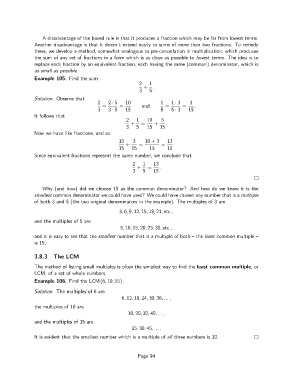
A disadvantage of the boxed rule is that it produces a fraction which may be far from lowest terms.
               Another disadvantage is that it doesn’t extend easily to sums of more than two fractions. To remedy
               these, we develop a method, somewhat analogous to pre-cancellation in multiplication, which produces
               the sum of any set of fractions in a form which is as close as possible to lowest terms.The idea is to
               replace each fraction by an equivalent fraction, each having the same (common) denominator, which is
               as small as possible.
               Example 105. Find the sum:
                                                           2   1
                                                             + .
                                                           3   5
               Solution. Observe that
                                          2   2 · 5  10             1    1 · 3  3
                                            =      =        and       =      =    .
                                          3   3 · 5  15             5    5 · 3  15
               It follows that
                                                      2   1   10    3
                                                        +   =    +    .
                                                      3   5   15    15
               Now we have like fractions, and so
                                                   10    3    10 + 3   13
                                                      +    =        =    .
                                                   15   15     15      15
               Since equivalent fractions represent the same number, we conclude that
                                                        2    1   13
                                                          +    =    .
                                                        3    5   15


                   Why (and how) did we choose 15 as the common denominator? And howdo we know it is the
               smallest common denominator we could have used? We could have chosen any number that is a multiple
               of both 3 and 5 (the two original denominators in the example). The multiples of 3 are
                                                   3, 6, 9, 12, 15, 18, 21, etc.,

               and the multiples of 5 are
                                                   5, 10, 15, 20, 25, 30, etc.,
               and it is easy to see that the smallest number that is a multiple of both – the least common multiple –
               is 15.

               3.8.3   The LCM

               The method of listing small multiples is often the simplest way to find the least common multiple,or
               LCM, of a set of whole numbers.
               Example 106. Find the LCM{6, 10, 15}.
               Solution. The multiples of 6 are
                                                    6, 12, 18, 24, 30, 36, ... ,
               the multiples of 10 are
                                                      10, 20, 30, 40, ... ,
               and the multiples of 15 are
                                                        15, 30, 45, ... .
               It is evident that the smallest number which is a multiple of all three numbers is 30.


                                                           Page 94

