


Page 104 - text book form physics kssm 2020
P. 104
Th  e square of the orbital period of any planet is
                      Kepler’s
                                   directly proportional to the cube of the radius
                     Th ird Law                                                   Mathematically,
                                   of its orbit (Law of Periods).                      T  ∝ r
                                                                                         2
                                                                                             3
                                                                                  T = orbital period of
                      A planet which orbits with a larger radius has a longer        a planet
                 orbital period. As such, planets which are further from the Sun   r =  radius of orbit
                 take a longer time to complete one orbit around the Sun.
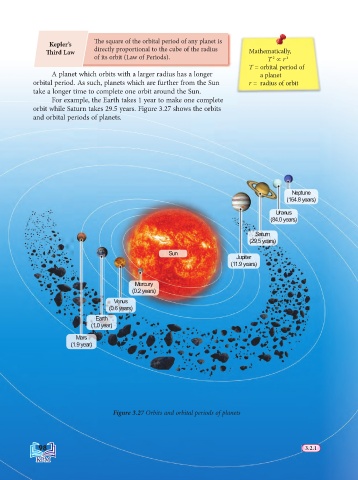
                      For example, the Earth takes 1 year to make one complete
                 orbit while Saturn takes 29.5 years. Figure 3.27 shows the orbits
                 and orbital periods of planets.


                                                                                               Neptune
                                                                                             (164.8 years)

                                                                                          U U U U
                                                                                          Uranus
                                                                                        (84.0 years)
                                                                                    S S
                                                                                    Saturnttt
                                                                                  (29.5 years)
                                                         Sun
                                                                              Jupiter
                                                                            (11.9 years)


                                               Mercury
                                               M M M M M M M
                                              (0.2 years)
                                         Venus
                                        (0.6 years)
                                    Earthtt
                                    E
                                  (1.0 year)
                              M M M M M
                              Mars
                            (1.9 year)


                                         Figure 3.27igure 3.27 Orbits and orbital periods of planets Orbits and orbital periods of planets
                                         F


                  98                                                                               3.2.1
                  98
                                                                                                   3.2.1

