


Page 126 - text book form physics kssm 2020
P. 126
4.1      Thermal Equilibrium


                 Observe Photograph 4.1. When a cold metal spoon
                 is put into a cup of hot coff ee, the spoon and the
                 coff ee are said to be in thermal contact because
                 heat energy can be transferred between the
                 two bodies. How can the metal spoon cool
                 down the hot coff ee? What is the fi nal
                 condition of the spoon and the coff ee?


                                                                 Photograph 4.1 A cold metal spoon in a cup of
                                                                 hot coffee
                         Activity 4.1

                  Aim: To show thermal equilibrium between two bodies in thermal contact
                  Apparatus: Two retort stands, two thermometers, 250 ml beaker labelled A, 50 ml beaker
                             labelled B, measuring cylinder and stopwatch
                  Materials:  50°C hot water, tap water and tissue paper

                  Instructions:
                  1.  Wrap beaker A with tissue and fi ll it with 150 ml of tap water.
                  2.  Fill 40 ml of 50°C hot water into beaker B.
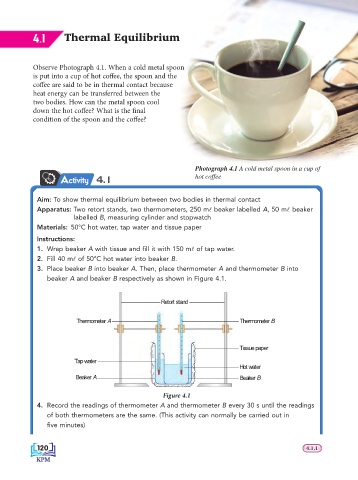
                  3.  Place beaker B into beaker A. Then, place thermometer A and thermometer B into
                       beaker A and beaker B respectively as shown in Figure 4.1.


                                                       Retort stand

                              Thermometer A                                    Thermometer B


                                                                               Tissue paper

                             Tap water
                                                                               Hot water
                              Beaker A                                         Beaker B


                                                        Figure 4.1
                  4.  Record the readings of thermometer A and thermometer B every 30 s until the readings
                     of both thermometers are the same. (This activity can normally be carried out in
                     fi ve minutes)


                  120
                  120                                                                              4.1.1
                                                                                                   4.1.1

