


Page 130 - text book form physics kssm 2020
P. 130
Thermometer            100°C                     100°C
                                                                       To power
                                              Retort                   supply
                                              stand
                                                                     Immersion                L 100
                                                                     heater
                   Ice +                0°C                          Boiling distilled
                   distilled water                                   water
                                                                                         0°C
                              Beaker A                    Beaker B

                                            Figure 4.4                                 Figure 4.5
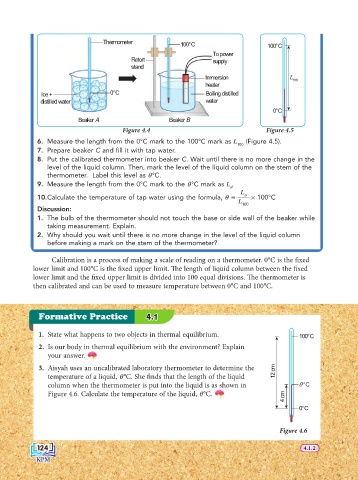
                  6.  Measure the length from the 0°C mark to the 100°C mark as L  (Figure 4.5).
                                                                              100
                  7.  Prepare beaker C and fi ll it with tap water.
                  8.  Put the calibrated thermometer into beaker C. Wait until there is no more change in the
                     level of the liquid column. Then, mark the level of the liquid column on the stem of the
                     thermometer.  Label this level as θ°C.
                  9.  Measure the length from the 0°C mark to the θ°C mark as L .
                                                                            θ
                                                                               L
                  10. Calculate the temperature of tap water using the formula, θ =   θ  × 100°C
                                                                              L 100
                  Discussion:
                  1.  The bulb of the thermometer should not touch the base or side wall of the beaker while
                     taking measurement. Explain.
                  2.  Why should you wait until there is no more change in the level of the liquid column
                     before making a mark on the stem of the thermometer?


                      Calibration is a process of making a scale of reading on a thermometer. 0°C is the fi xed
                 lower limit and 100°C is the fi xed upper limit. Th  e length of liquid column between the fi xed
                 lower limit and the fi xed upper limit is divided into 100 equal divisions. Th  e thermometer is
                 then calibrated and can be used to measure temperature between 0°C and 100°C.


                                                   4.1
                  Formative Practice               4.1

                  1.  State what happens to two objects in thermal equilibrium.                  100°C
                  2.  Is our body in thermal equilibrium with the environment? Explain
                     your answer.
                  3.  Aisyah uses an uncalibrated laboratory thermometer to determine the   12 cm
                     temperature of a liquid, θ°C. She fi nds that the length of the liquid
                     column when the thermometer is put into the liquid is as shown in           θ °C
                     Figure 4.6. Calculate the temperature of the liquid, θ°C.
                                                                                            4 cm
                                                                                                 0°C


                                                                                           Figure 4.6
                  124
                  124
                  124
                  124                                                                             4.1.2
                                                                                                  4.1.2

