


Page 129 - text book form physics kssm 2020
P. 129
Chapter 4
                                                                                                     Heat
                  To Calibrate a Liquid-in-glass Thermometer Using Two Fixed Points


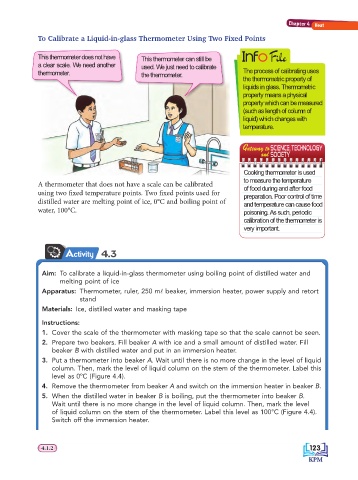
                  This thermometer does not have   This thermometer can still be        File
                  a clear scale. We need another   used. We just need to calibrate
                  thermometer.                   the thermometer.               The process of calibrating uses
                                                                                the thermometric property of
                                                                                liquids in glass. Thermometric
                                                                                property means a physical
                                                                                property which can be measured
                                                                                (such as length of column of
                                                                                liquid) which changes with
                                                                                temperature.


                                                                                 ateway to SCIENCE, TECHNOLOGY
                                                                                     and  SOCIETY

                                                                                Cooking thermometer is used
                                                                                to measure the temperature
                  A thermometer that does not have a scale can be calibrated    of food during and after food
                  using two fi xed temperature points. Two fi xed points used for   preparation. Poor control of time
                  distilled water are melting point of ice, 0°C and boiling point of   and temperature can cause food
                  water, 100°C.                                                 poisoning. As such, periodic
                                                                                calibration of the thermometer is
                                                                                very important.


                           Activity 4.3


                   Aim:  To calibrate a liquid-in-glass thermometer using boiling point of distilled water and
                         melting point of ice
                   Apparatus:  Thermometer, ruler, 250 ml beaker, immersion heater, power supply and retort
                               stand
                   Materials:  Ice, distilled water and masking tape
                   Instructions:
                   1.  Cover the scale of the thermometer with masking tape so that the scale cannot be seen.
                   2.  Prepare two beakers. Fill beaker A with ice and a small amount of distilled water. Fill
                      beaker B with distilled water and put in an immersion heater.
                   3.  Put a thermometer into beaker A. Wait until there is no more change in the level of liquid
                      column. Then, mark the level of liquid column on the stem of the thermometer. Label this
                      level as 0ºC (Figure 4.4).
                   4.  Remove the thermometer from beaker A and switch on the immersion heater in beaker B.
                   5.  When the distilled water in beaker B is boiling, put the thermometer into beaker B.
                      Wait until there is no more change in the level of liquid column. Then, mark the level
                      of liquid column on the stem of the thermometer. Label this level as 100°C (Figure 4.4).
                      Switch off the immersion heater.


                                                                                                    123
                   4.1.2                                                                            123
                   4.1.2

