


Page 131 - text book form physics kssm 2020
P. 131
Chapter 4
                                                                                              Chapter 4
                                                                                                     Heat
                                                                                                     Heat
                  4.2       Specific Heat Capacity


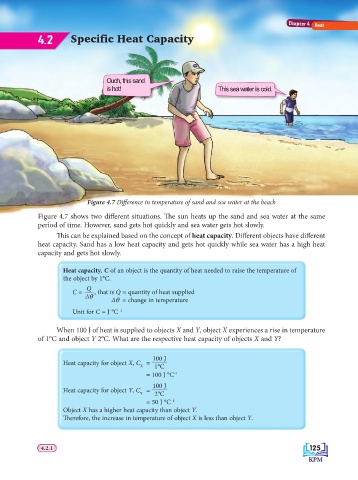
                                       Ouch, this sand
                                       is hot!                          This sea water is cold.


                                 Figure 4.7 Diff erence in temperature of sand and sea water at the beach

                  Figure 4.7 shows two diff erent situations. Th  e sun heats up the sand and sea water at the same
                  period of time. However, sand gets hot quickly and sea water gets hot slowly.
                        Th  is can be explained based on the concept of heat capacity. Diff erent objects have diff erent
                  heat capacity. Sand has a low heat capacity and gets hot quickly while sea water has a high heat
                  capacity and gets hot slowly.


                          Heat capacity, C of an object is the quantity of heat needed to raise the temperature of
                          the object by 1°C.
                                 Q
                             C =   , that is Q = quantity of heat supplied
                                Δθ
                                        Δθ  = change in temperature
                             Unit  for  C = J °C –1

                        When 100 J of heat is supplied to objects X and Y, object X experiences a rise in temperature
                  of 1°C and object Y 2°C. What are the respective heat capacity of objects X and Y?

                                                     100 J
                          Heat capacity for object X, C =
                                                 X   1°C
                                                   = 100 J °C –1

                                                     100 J
                          Heat capacity for object Y, C =
                                                 Y   2°C
                                                   = 50 J °C –1
                          Object X has a higher heat capacity than object Y.
                          Th  erefore, the increase in temperature of object X is less than object Y.


                                                                                                    125
                   4.2.1                                                                            125
                   4.2.1

