


Page 143 - text book form physics kssm 2020
P. 143
Chapter 4
                                                                                                     Heat
                  4.3       Specific Latent Heat


                  Latent Heat

                  Elements can exist in three states: solid, liquid and gas. Th e diff erence in the arrangement and
                  movement of molecules among the three states of matter shows that there are stronger molecular
                  bonds in solid than in liquid and gas. As gas molecules move freely at random, the bond between
                  gas molecules is the weakest.
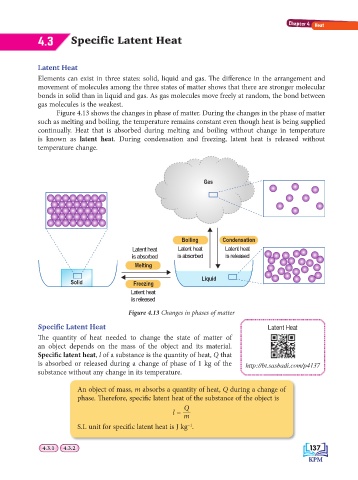
                        Figure 4.13 shows the changes in phase of matter. During the changes in the phase of matter
                  such as melting and boiling, the temperature remains constant even though heat is being supplied
                  continually. Heat that is absorbed during melting and boiling without change in temperature
                  is known as  latent heat. During condensation and freezing, latent heat is released without
                  temperature change.


                                                                    *DV


                                                             %RLOLQJ      &RQGHQVDWLRQ
                                               Latent heat  Latent heat   Latent heat
                                              is absorbed   is absorbed    is released
                                               0HOWLQJ
                                                                   /LTXLG
                            6ROLG              )UHH]LQJ
                                              Latent heat
                                              is released

                                             Figure 4.13 Changes in phases of matter
                  Specifi c Latent Heat                                                 Latent Heat
                  Th  e quantity of heat needed to change the state of matter of
                  an object depends on the mass of the object and its material.
                  Specifi c latent heat, l of a substance is the quantity of heat, Q that
                  is absorbed or released during a change of phase of 1 kg of the   http://bt.sasbadi.com/p4137
                  substance without any change in its temperature.

                              An object of mass, m absorbs a quantity of heat, Q during a change of
                              phase. Th erefore, specifi c latent heat of the substance of the object is
                                                              Q
                                                           l =
                                                              m
                                                               −1
                              S.I. unit for specifi c latent heat is J kg .

                                                                                                    137
                                                                                                    137
                          4.3.2
                    4.3.1  4.3.2                                                                    137
                    4.3.1

