


Page 215 - King Lear: The Cambridge Dover Wilson Shakespeare
P. 215
140


                                  NOTES


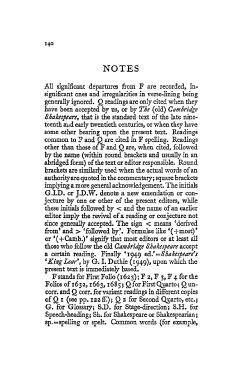
               All  significant  departures  from  F  are  recorded,  in-
               significant  ones and  irregularities in  verse-lining  being
               generally ignored.  Q readings are only cited when they
               have  been accepted  by us, or  by The  (old)  Cambridge
               Shakespeare,  that  is the standard  text  of the late nine-
               teenth aud early twentieth centuries, or when they have
               some  other  bearing  upon  the  present  text.  Readings
               common to F  and Q are cited in F  spelling.  Readings
               other  than  those of F and Q are, when  cited,  followed
               by the name  (within  round  brackets and  usually in an
               abridged form) of the text or editor responsible.  Round
                brackets are similarly used when the actual words of an
               authority are quoted in the commentary; square brackets
               implying a more general acknowledgement. The initials
                G.I.D.  or J.D.W. denote a  new  emendation  or  con-
               jecture  by  one  or  other  of  the  present  editors, while
                these initials followed  by  <  and the name of an earlier
               editor imply the revival of a reading or conjecture  hot
               since generally accepted. The  sign  <  means  'derived
               from'  and  >  'followed  by*.  Formulae like '(+most)'
                or '(+Camb.)'  signify that  most editors or at  least all
               those who follow the old Cambridge Shakespeare accept
               a  certain  reading.  Finally  '1949  ed.'=Shakespeare's
                          1
                'King  Lear ', by G. I. Duthie (1949), upon which the
                present text is immediately based.
                  F stands for First Folio (1623); F 2, F  3, F 4 for the
                Folios of 1632,1663,1685; Q for First Quarto; Qun-
                corr. and Q corr. for variant readings in different copies
                of Q 1 (see pp. 122ff.);  Q 2  for  Second Quarto, etc.;
                G.  for  Glossary;  S.D.  for  Stage-direction;  S.H.  for
                Speech-heading; Sh. for  Shakespeare or Shakespearian;
                sp.=spelling  or  spelt.  Common  words  (for  example,

