


Page 100 - BBC Wildlife Volume 36 #02
P. 100
Q&A                                                                                                Q&A


                            WHAT                                   Q  FRESHWATER FISH

                            IS IT?                                How do archerfish
                                                                  use water as a


                                                                  weapon?


                                                                   A   Woe betide any insect perching on a leafy
                                                                  frond near the water’s edge if an archerfish lurks
                                                                  nearby. This predator can strike its prey with a
                                                                  mouthful of water from up to three metres away,
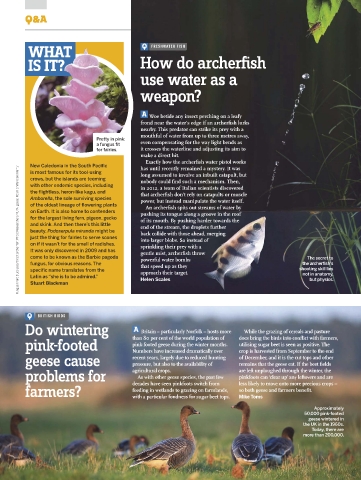
                                                    Pretty in pink:
                                                    a fungus fit   even compensating for the way light bends as
                                                    for fairies.  it crosses the waterline and adjusting its aim to
                                                                  make a direct hit.
                                                                    Exactly how the archerfish water pistol works
                             New Caledonia in the South Pacific
                         Fungus: Marc Ducousso/Cirad; archerfish: Photo Researchers/FLPA; geese: Robin Chittenden/Alamy
                                                                  has until recently remained a mystery. It was
                             is most famous for its tool-using
                                                                  long assumed to involve an inbuilt catapult, but
                             crows, but the islands are teeming
                                                                  nobody could find such a mechanism. Then,
                             with other endemic species, including
                                                                  in 2012, a team of Italian scientists discovered
                             the flightless, heron-like kagu, and
                                                                  that archerfish don’t rely on catapults or muscle
                             Amborella, the sole surviving species
                                                                  power, but instead manipulate the water itself.
                             of the oldest lineage of flowering plants
                                                                    An archerfish spits out streams of water by
                             on Earth. It is also home to contenders
                                                                  pushing its tongue along a groove in the roof
                             for the largest living fern, pigeon, gecko
                                                                  of its mouth. By pushing harder towards the
                             and skink. And then there’s this little
                                                                  end of the stream, the droplets further
                             beauty. Podoserpula miranda might be
                                                                  back collide with those ahead, merging
                             just the thing for fairies to serve scones
                                                                  into larger blobs. So instead of
                             on if it wasn’t for the smell of radishes.
                                                                  sprinkling their prey with a
                             It was only discovered in 2009 and has
                                                                  gentle mist, archerfish throw
                             come to be known as the Barbie pagoda                                                         The secret to
                                                                  powerful water bombs
                             fungus, for obvious reasons. The                                                            the archerfish’s
                                                                  that speed up as they
                             specific name translates from the                                                           shooting skill lies
                                                                  approach their target.                                 not in anatomy,
                             Latin as “she is to be admired.”
                                                                  Helen Scales                                              but physics.
                             Stuart Blackman
                            Q   BRITISH BIRDS
                           Do wintering                         A  Britain – particularly Norfolk – hosts more   While the grazing of cereals and pasture
                                                                than 80 per cent of the world population of   does bring the birds into conflict with farmers,
                           pink-footed                          pink-footed geese during the winter months.   utilising sugar beet is seen as positive. The
                                                                Numbers have increased dramatically over
                                                                                                    crop is harvested from September to the end
                           geese cause                          recent years, largely due to reduced hunting   of December, and it is the cut tops and other
                                                                pressure, but also to the availability of
                                                                                                    remains that the geese eat. If the beet fields
                           problems for                         agricultural crops.                 are left unploughed through the winter, the
                                                                                                    pinkfoots can ‘clear up’ any leftovers and are
                                                                 As with other geese species, the past few
                                                                decades have seen pinkfoots switch from   less likely to move onto more precious crops –
                           farmers?                             feeding in wetlands to grazing on farmlands,   so both geese and farmers benefit.
                                                                                                    Mike Toms
                                                                with a particular fondness for sugar beet tops.
                                                                                                                             Approximately
                                                                                                                          50,000 pink-footed
                                                                                                                           geese wintered in
                                                                                                                         the UK in the 1960s.
                                                                                                                            Today, there are
                                                                                                                         more than 200,000.

