


Page 98 - BBC Wildlife Volume 36 #02
P. 98
Q Q Q Q                                              A
                                                  Q&
                              THE PANEL
                              THE P  ANEL


                                MATT DOGGETT
                                Marine biolog gist


                               SARAH MCPHERSON
                                  Q&A editor
                                                                                LVE YOUR MYSTERIES. MORE AMAZING
                                                                        FACTS AT WWW.DISCOVERWILDLIFE.COM


                              MICHAEL ENGELHARD       Q   MARINE BIOLOGY
                              Author and wildlife g guide
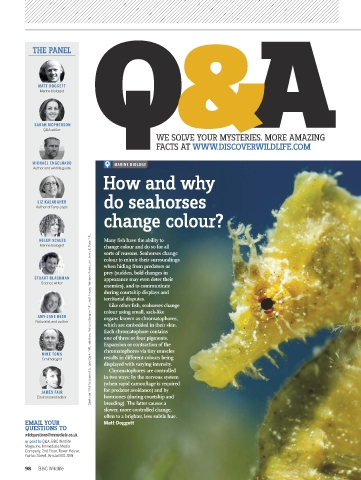
                                                      How and why


                                LIZ KALAUGHER         do seahorses
                                        ogic
                                uthor
                                       L
                                     urry
                                    F
                                   o
                                    f
                               Author of Furry Logic
                               A
                                                      change colour?
                                 HELEN SCALES         Many fish have the ability to
                                Marine biologist      change colour and do so for all
                                                      sorts of reasons. Seahorses change
                                                      colour to mimic their surroundings
                                                      when hiding from predators or
                                                      prey (sudden, bold changes in
                               STUART BLACKMAN        appearance may even deter their
                                       er
                                     writ
                                    e
                                 S Science writer
                                 cienc
                                                      enemies), and to communicate
                                                      during courtship displays and
                                                      territorial disputes.
                                                        Like other fish, seahorses change
                                                      colour using small, sack-like
                                AMY-JANE BEER         organs known as chromatophores,
                               Naturalist and author Seahorse: Wild Wonders of Europe/Zankl/NPL; elephant: Francois Savigny/NPL; seal: Andrey Nekrasov/Alamy; owl: Jenny E. Ross/NPL
                                                      which are embedded in their skin.
                                                      Each chromatophore contains
                                                      one of three or four pigments.
                                                      Expansion or contraction of the
                                                      chromatophores via tiny muscles
                                 MIKE TOMS
                                 Ornithologist t      results in different colours being
                                  rnithologis
                                 O
                                                      displayed with varying intensity.
                                                        Chromatophores are controlled
                                                      in two ways: by the nervous system
                                                      (when rapid camouflage is required
                                                      for predator avoidance) and by
                                 JAMES FAIR
                                      edit
                                 vir
                                  onment
                                n
                               Environment editoror   hormones (during courtship and
                               E
                                                      breeding). The latter causes a
                                                      slower, more controlled change,
                                                      often to a brighter, less subtle hue.
                           EMAIL YOUR                 Matt Doggett
                           QUESTIONS TO
                           wildquestions@immediate.co.uk
                           or post to Q&A, BBC Wildlife
                           Magazine, Immediate Media
                           Company, 2nd Floor, Tower House,
                           Fairfax Street, Bristol BS1 3BN
                           98   BBC Wildlife

