


Page 102 - BBC Wildlife Volume 36 #02
P. 102
Q&A


                            Q  BOTANY
                                                                                                 Q  BIOLOGY
                           What is an ancient                                                    Why do animals


                           woodland indicator?                                                   hiccup?

                                                                                                 A  Hiccups are at least as intriguing as they
                            A   In England and                        ancient woodlands usually  are inconvenient. These noisy gulps and/or
                           Wales, a woodland is                          have a greater abundance  belches induced by involuntary contractions
                           deemed ancient if it                            of plants that spread   of the diaphragm seem to be far from useful
                           has existed with                                  slowly over the     in adults, but there’s evidence that they
                           continuous tree                                    ground, such as    serve to help expel air from the stomach in
                           cover since at                                      wood anemone,     suckling infant mammals. Indeed, we get
                           least 1600                                          wood sorrel and   hiccups less often as we age. They might
                           (1750 in                                             ransoms, and     have truly ancient evolutionary origins. A
                           Scotland). The                                       those whose      hiccup-like reflex enables tadpoles to divert
                           distinction                                          seeds fall close  water to the gills and air to the lungs as they
                           may seem                                            to the parent, as  transition to air-breathing adults – just as
                           arbitrary, but                                      do those of the   our piscine ancestors would have had to do
                           acknowledges                                        wild service tree.  on the way to conquering the land.
                                                               Wood anemones
                           the fact that older                 are slow to colonise,   These plants,            Stuart Blackman
                           tree-ed landscapes                  advancing just 1.8m    along with
                           tend to have greater                in 100 years.   guelder rose,
                           ecological value.                                   wood spurge
                             To determine the age of a             and small leaved lime, are some
                           woodland, you can consult historic maps  of our most common ancient woodland                  Hiccups help
                           and records, or you can get out and look   indicators. As well as being slow-growers,         tadpoles
                           at its flora. Newer woodlands tend to be  they require long-term, stable woodland              to transition.
                           big on the pioneer species – those with  cover to survive and are easy to recognise.
                           windblown seeds, for instance, while  Amy-Jane Beer


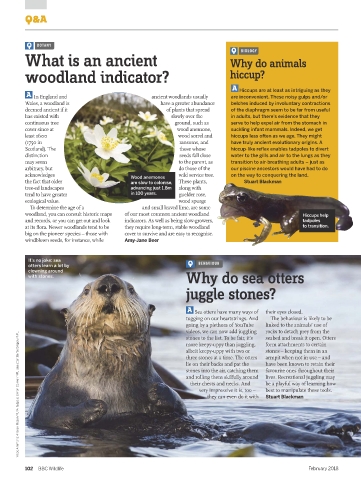
                            It’s no joke: sea
                            otters learn a lot by                                 Q   BEHAVIOUR
                            clowning around
                            with stones.


                                                                                  A   Sea otters have many ways of   their eyes closed.
                                                                                  tugging on our heartstrings. And   The behaviour is likely to be
                                                                                  going by a plethora of YouTube   linked to the animals’ use of
                                                                                  videos, we can now add juggling   rocks to detach prey from the
                         Wood Anemone: Andrew Mason/FLPA; tadpole: Simon Colmer/NPL; sea otter: Bertie Gregory/NPL
                                                                                  stones to the list. To be fair, it’s   seabed and break it open. Otters
                                                                                  more keepy-uppy than juggling,   form attachments to certain
                                                                                  albeit keepy-uppy with two or   stones – keeping them in an
                                                                                  three stones at a time. The otters   armpit when not in use – and
                                                                                  lie on their backs and pat the   have been known to retain their
                                                                                  stones into the air, catching them   favourite ones throughout their
                                                                                  and rolling them skilfully around   lives. Recreational juggling may
                                                                                   their chests and necks. And   be a playful way of learning how
                                                                                      very impressive it is, too –   best to manipulate these tools.
                                                                                         they can even do it with   Stuart Blackman


                           102  BBC Wildlife                                                                               February 2018

