


Page 99 - BBC Wildlife Volume 36 #02
P. 99
Q&A


                           Q AFRICAN MAMMALS
                                                                 Q   ARCTIC WILDLIFE
                            Can elephants be
                            right- or left-tusked?
                             A  Yes. Just as humans are right- or left-
                             handed, elephants are known to use one
                             tusk more than the other. This favoured
                             appendage is sometimes referred to as
                                     the ‘master tusk’ and often  A  Dogs – namely labrador retrievers –   annual movements. Their research revealed
                                      appears more worn. Tusks   have played an important role in ringed seal   that ringed seal subpopulations interbreed
                                      are evolved from teeth and   research, a challenge to carry out on the   throughout the Arctic, reducing the species’
                                      have all sorts of uses – in   snowy wastes of Arctic sea ice.  vulnerability to extinction; and that earlier
                                                                                                   snowmelt, driven by climate change,
                                                                                  seal
                                                                             about
                                                                                 ‘
                                                                                     dogs
                                                                                             an
                                                                    ter
                                                                       learning
                                                                  Af
                                                                                         from
                                                                                        ’
                                     defence, as weapons, for     After learning about seal dogs from an   snowmelt  driven  by  climate  change
                                    stripping bark, foraging     Inuit hunter, marine biologist Brendan  is exposing the pups sooner and more
                                   and digging. Sarah McPherson  Kelly from the University of Alaska used   frequently to the elements and predators,
                                                                 labradors to sniff out breathing holes and  such as polar bears and Arctic foxes.
                                                                 lairs (caves dug in the snowdrifts over  Michael Engelhard
                                                                 breathing holes, which females use to rest
                                         Seahorses – here a short-
                                           snouted – can change   and nurse their pups). The dogs
                                          colour quickly, blending   boasted an 80–85 per cent
                                             into their habitat to     success rate in a search area
                                             hide from predators.   5–10km wide, pinpointing
                                                                 up to 200 lairs and holes
                                                                 in a month.
                                                                  Thanks to their canine
                                                                 assistants, Kelly and his
                                                                 team were able to secure
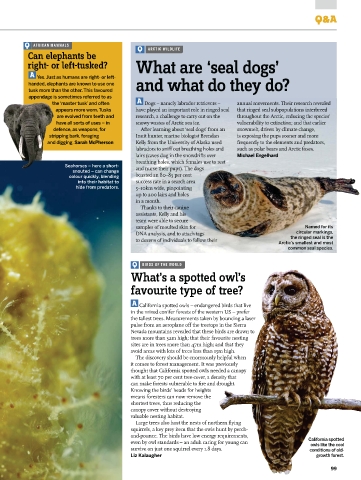
                                                                 samples of moulted skin for                              Named for its
                                                                 DNA analysis, and to attach tags                      circular markings,
                                                                                                                     the ringed seal is the
                                                                 to dozens of individuals to follow their
                                                                                                                 Arctic’s smallest and most
                                                                                                                    common seal species.
                                                                Q  BIRDS OF THE WORLD
                                                               What’s a spotted owl’s
                                                               favourite type of tree?
                                                                A   California spotted owls – endangered birds that live

                                                               in the mixed conifer forests of the western US – prefer
                                                               the tallest trees. Measurements taken by bouncing a laser
                                                               pulse from an aeroplane off the treetops in the Sierra
                                                               Nevada mountains revealed that these birds are drawn to
                                                               trees more than 32m high; that their favourite nesting
                                                               sites are in trees more than 47m high; and that they
                                                               avoid areas with lots of trees less than 15m high.
                                                                 The discovery should be enormously helpful when
                                                               it comes to forest management. It was previously
                                                               thought that California spotted owls needed a canopy
                                                               with at least 70 per cent tree-cover, a density that
                                                               can make forests vulnerable to fire and drought.
                                                               Knowing the birds’ heads for heights
                                                               means foresters can now remove the
                                                               shortest trees, thus reducing the
                                                               canopy cover without destroying
                                                               valuable nesting habitat.
                                                                 Large trees also host the nests of northern flying
                                                               squirrels, a key prey item that the owls hunt by perch-
                                                               and-pounce. The birds have low energy requirements,
                                                                                                                           California spotted
                                                               even by owl standards – an adult caring for young can
                                                                                                                            owls like the cool
                                                               survive on just one squirrel every 1.8 days.                 conditions of old-
                                                               Liz Kalaugher                                                  growth forest.
                           February 2018                                                                                           99

