


Page 29 - BBC Wildlife Volume 36 #02
P. 29
BRITISH BEAVERS


                          “ WITHIN A FORTNIGHT OF THEIR RELEASE

                           THE BEAVERS’ HANDIWORK WAS HOLDING
                           BACK 1,000 CUBIC METRES OF WATER.”

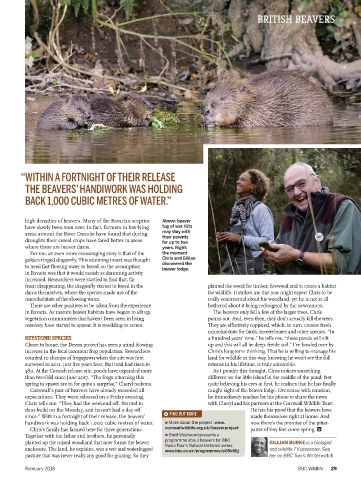
                           high densities of beavers. Many of the Bavarian sceptics   Above: beaver
                           have slowly been won over. In fact, farmers in low-lying   tug of war. Kits
                                                                          may stay with
                           areas around the River Danube have found that during
                                                                          their parents
                           droughts their cereal crops have fared better in areas
                                                                          for up to two
                           where there are beaver dams.                   years. Right:
                             For me, an even more encouraging story is that of the   the moment
                           golden-ringed dragonfly. This stunning insect was thought   Chris and Gillian
                                                                          discovered the
                           to need fast-flowing water to breed, so the assumption
                                                                          beaver lodge.
                           in Bavaria was that it would vanish as damming activity
                           increased. Researchers were startled to find that, far
                           from disappearing, the dragonfly started to breed in the       planted the wood for timber, firewood and to create a habitat
                           dams themselves, where the species made use of the            for wildlife. It strikes me that you might expect Chris to be
                           microhabitats of fast-flowing water.                           really sentimental about his woodland, yet he is not at all
                             There are other positives to be taken from the experience   bothered about it being redesigned by the newcomers.
                           in Bavaria. As mature beaver habitats have begun to silt up,    The beavers only fell a few of the larger trees, Chris
                           vegetation communities that haven’t been seen in living       points out. And, even then, they don’t actually kill the trees.
                           memory have started to appear. It is rewilding in action.     They are effectively coppiced, which, in turn, creates fresh
                                                                                         microhabitats for birds, invertebrates and other species. “In
                           KEYSTONE SPECIES                                              a hundred years’ time,” he tells me, “these ponds will silt
                           Closer to home, the Devon project has seen a mind-blowing     up and this will all be deep, fertile soil.” I’m bowled over by
                           increase in the local common frog population. Researchers     Chris’s long-term thinking. That he is willing to manage his
                           counted 10 clumps of frogspawn when the site was first         land for wildlife in this way, knowing he won’t see the full
                           surveyed in 2011. Just five years later, that total had risen to   returns in his lifetime, is truly admirable.
                           580. At the Cornish release site, ponds have expanded more      As I ponder this thought, Chris notices something
                           than two-fold since June 2017. “The frogs returning this      different on the little island in the middle of the pond. Not
                           spring to spawn are in for quite a surprise,” Cheryl reckons.  quite believing his eyes at first, he realises that he has finally
                             Cornwall’s pair of beavers have already exceeded all        caught sight of the beaver lodge. Overcome with emotion,
                           expectations. They were released on a Friday evening,         he immediately reaches for his phone to share the news
                        Beavers: Nick Upton; Gillian: Nina Constable  since.” Within a fortnight of their release, the beavers’   +  FIND OUT MORE  made themselves right at home. And
                           Chris tells me. “They had the weekend off. Started to
                                                                                         with Cheryl and his partners at the Cornwall Wildlife Trust.
                           dam-build on the Monday, and haven’t had a day off
                                                                                                        He has his proof that the beavers have
                                                                                                        now there’s the promise of the pitter-
                                                                           O More about the project: www.
                           handiwork was holding back 1,000 cubic metres of water.
                                                                           cornwallwildlife.org.uk/beaverproject
                             Chris’s family has farmed here for three generations.
                                                                                                        patter of tiny feet come spring.
                                                                           O Brett Westwood presents a
                           Together with his father and brothers, he personally
                                                                           programme about beavers for BBC
                           enclosure. The land, he explains, was a wet and waterlogged
                                                                                                              and wildlife TV presenter. See
                                                                           www.bbc.co.uk/programmes/p05k6fjj
                           pasture that was never really any good for grazing. So they
                                                                                                              her on BBC Two’s Winterwatch.
                           planted up the mixed woodland that now forms the beaver   Radio Four’s Natural Histories series:   GILLIAN BURKE is a biologist
                           February 2018                                                                                BBC Wildlife  29

