


Page 49 - BBC Wildlife Volume 36 #02
P. 49
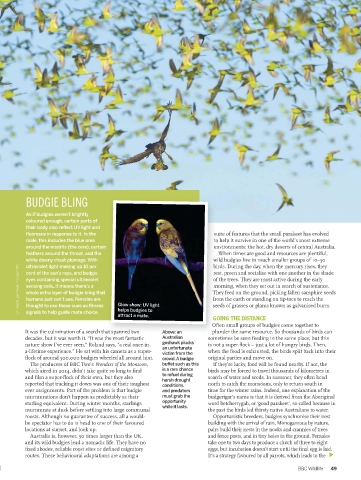
BUDGIE BLING

                            As if budgies weren’t brightly
                            coloured enough, certain parts of
                            their body also reflect UV light and
                            fluoresce in response to it. In the                             s uite of features that the small parakeet has evolved
                                                                                            o help it survive in one of the world’s most extreme
                            male, this includes the blue area                              to
                                                                                           e
                            around the nostrils (the cere), certain                        environments: the hot, dry deserts of central Australia.
                            feathers around the throat, and the                              When times are good and resources are plentiful,
                                                                                           wild budgies live in much smaller groups of 10–50
                            white downy chest plumage. With                                w est, preen and socialise with one another in the shade
                         UV: Albert Lleal/Minden Pictures/FLPA  eyes containing special ultraviolet   Th
                                                                                            irds. During the day, when the mercury rises, they
                                                                                           b
                            ultraviolet light making up 10 per
                                                                                           re
                            cent of the sun’s rays, and budgie
                                                                                            f the trees. They are most active during the early
                                                                                           o
                                                                                           morning, when they set out in search of sustenance.
                                                                                           m
                            sensing cells, it means there’s a
                                                                                            hey feed on the ground, picking fallen samphire seeds
                            whole extra layer of budgie bling that
                                                                                           rom the earth or standing on tip-toes to reach the
                                                                                           fr
                            humans just can’t see. Females are
                                                           Glow show: UV light
                            thought to use these cues as fitness
                                                           helps budgies to
                            signals to help guide mate choice.
                                                           attract a mate.                 se eeds of grasses or plants known as galvanised burrs.
                                                                                           G
                                                                                           GOING THE DISTANCE
                                                                                           O ften small groups of budgies come together to
                                                         sp
                                                          anned two
                           It was the culmination of a search that spanned two  Above: an   plunder the same resource. So thousands of birds can
                                                                                           pl
                                                       a
                                                        t
                           decades, but it was worth it. “It was the most fantastic   Australian   sometimes be seen feeding in the same place, but this
                           nature show I’ve ever seen,” Roland says, “a real once-in-  goshawk plucks   is not a super-flock – just a lot of hungry birds. Then,
                                                                          an unfortunate
                           a-lifetime experience.” He sat with his camera as a super-    when the food is exhausted, the birds split back into their
                                                                          victim from the
                           flock of around 500,000 budgies wheeled all around him.  crowd. A budgie   original parties and move on.
                             The producers of BBC Two’s Wonders of the Monsoon,   buffet such as this   If they’re lucky, food will be found nearby. If not, the
                           which aired in 2014, didn’t take quite so long to find   is a rare chance  birds may be forced to travel thousands of kilometres in
                                                                          to refuel during
                           and film a super-flock of their own, but they also              search of water and seeds. In summer, they often head
                                                                          harsh drought
                           reported that tracking it down was one of their toughest   conditions,   north to catch the monsoons, only to return south in
                           ever assignments. Part of the problem is that budgie   and predators   time for the winter rains. Indeed, one explanation of the
                           murmurations don’t happen as predictably as their   must grab the   budgerigar’s name is that it is derived from the Aboriginal
                           starling equivalent. During winter months, starlings   opportunity   word betcherrygah, or ‘good parakeet’, so-called because in
                                                                          while it lasts.
                           murmurate at dusk before settling into large communal         the past the birds led thirsty native Australians to water.
                           roosts. Although no guarantee of success, all a would-          Opportunistic breeders, budgies synchronise their nest
                           be spectator has to do is head to one of their favoured       building with the arrival of rain. Monogamous by nature,
                           locations at sunset, and look up.                             pairs build their nests in the nooks and crannies of trees
                             Australia is, however, 30 times larger than the UK,         and fence posts, and in tiny holes in the ground. Females
                           and its wild budgies lead a nomadic life. They have no        take one to two days to produce a clutch of three to eight
                           fixed abodes, reliable roost sites or defined migratory         eggs, but incubation doesn’t start until the final egg is laid.
                           routes. These behavioural adaptations are among a             It’s a strategy favoured by all parrots, which leads to the
                                                                                                                        BBC Wildlife  49

