


Page 51 - BBC Wildlife Volume 36 #02
P. 51
BUDGIES


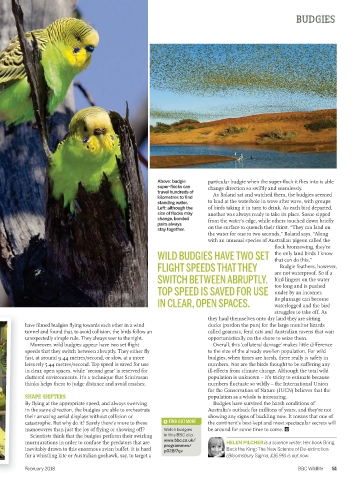
                                                                        Above: budgie    particular budgie when the super-flock it flies into is able
                                                                        super-flocks can   change direction so swiftly and seamlessly.
                                                                        travel hundreds of  As Roland sat and watched them, the budgies seemed
                                                                        kilometres to find
                                                                        standing water.   to land at the waterhole in wave after wave, with groups
                                                                        Left: although the   of birds taking it in turn to drink. As each bird departed,
                                                                        size of flocks may   another was always ready to take its place. Some sipped
                                                                        change, bonded   from the water’s edge, while others touched down briefly
                                                                        pairs always
                                                                        stay together.   on the surface to quench their thirst. “They can land on
                                                                                         the water for one to two seconds,” Roland says. “Along
                                                                                         with an unusual species of Australian pigeon called the
                                                                                                                flock bronzewing, they’re
                                                                                                                the only land birds I know
                                                                        WILD BUDGIES HAVE TWO SET               that can do this.”
                                                                                                                 Budgie feathers, however,
                                                                                                                are not waterproof. So if a
                                                                        FLIGHT SPEEDS THAT THEY
                                                                                                                bird lingers on the water
                                                                        SWITCH BETWEEN ABRUPTLY.
                                                                                                                too long and is pushed
                                                                                                                under by an incomer,
                                                                        TOP SPEED IS SAVED FOR USE
                                                                                                                its plumage can become
                                                                                                                waterlogged and the bird
                                                                        IN CLEAR, OPEN SPACES.
                                                                                                                struggles to take off. As
                                                                                         they haul themselves onto dry land they are sitting
                           have filmed budgies flying towards each other in a wind         ducks (pardon the pun) for the large monitor lizards
                           tunnel and found that, to avoid collision, the birds follow an  called goannas, feral cats and Australian ravens that wait
                           unexpectedly simple rule. They always veer to the right.      opportunistically on the shore to seize them.
                             Moreover, wild budgies appear have two set flight              Overall, this ‘collateral damage’ makes little difference
                           speeds that they switch between abruptly. They either fly      to the size of the already swollen population. For wild
                           fast, at around 9.44 metres/second, or slow, at a more        budgies, when times are harsh, there really is safety in
                           leisurely 5.44 metres/second. Top speed is saved for use      numbers. Nor are the birds thought to be suffering any
                           in clear, open spaces, while ‘second gear’ is reserved for    ill-effects from climate change. Although the total wild
                           cluttered environments. It’s a technique that Srinivasan      population is unknown – it’s tricky to estimate because
                           thinks helps them to judge distance and avoid crashes.        numbers fluctuate so wildly – the International Union
                                                                                         for the Conservation of Nature (IUCN) believes that the
                           SHAPE SHIFTERS                                                population as a whole is increasing.
                           By flying at the appropriate speed, and always swerving          Budgies have survived the harsh conditions of
                           in the same direction, the budgies are able to orchestrate    Australia’s outback for millions of years, and they’re not
                           their amazing aerial displays without collision or            showing any signs of buckling now. It means that one of
                           catastrophe. But why do it? Surely there’s more to these   +  FIND OUT MORE  the continent’s best-kept and most spectacular secrets will
                           manoeuvres than just the joy of flying or showing off?  Watch budgies   be around for some time to come.
                             Scientists think that the budgies perform their swirling  in this BBC clip:
                                                                          www.bbc.co.uk/
                           murmurations in order to confuse the predators that are             HELEN PILCHER is a science writer. Her book Bring
                                                                          programmes/
                           inevitably drawn to this enormous avian buffet. It is hard          Back the King: The New Science of De-extinction
                                                                          p028f7qv
                           for a whistling kite or Australian goshawk, say, to target a        (Bloomsbury Sigma, £16.99) is out now.
                           February 2018                                                                                BBC Wildlife  51

