


Page 50 - BBC Wildlife Volume 36 #02
P. 50
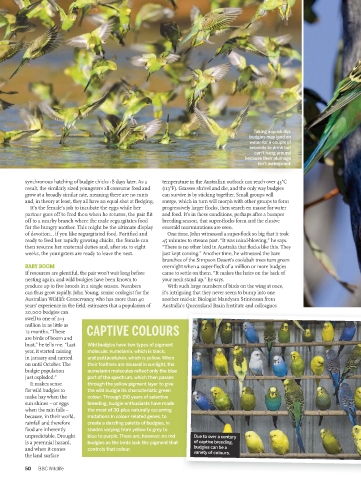
Taking a quick dip:
                                                                                                       budgies may land on
                                                                                                       water for a couple of
                                                                                                       seconds to drink but
                                                                                                         can’t hang around
                                                                                                      because their plumage
                                                                                                          isn’t waterproof.


                           synchronous hatching of budgie chicks 18 days later. As a  temperature in the Australian outback can reach over 45°C
                           result, the similarly sized youngsters all consume food and  (113°F). Grasses shrivel and die, and the only way budgies
                           grow at a broadly similar rate, meaning there are no runts  can survive is by sticking together. Small groups will
                           and, in theory at least, they all have an equal shot at fledging.   merge, which in turn will morph with other groups to form
                             It’s the female’s job to incubate the eggs while her  progressively larger flocks, then search en masse for water
                           partner goes off to feed then when he returns, the pair flit   and food. It’s in these conditions, perhaps after a bumper
                           off to a nearby branch where the male regurgitates food  breeding season, that super-flocks form and the elusive
                           for the hungry mother. This might be the ultimate display   emerald murmurations are seen.
                           of devotion… if you like regurgitated food. Fortified and  One time, John witnessed a super-flock so big that it took
                           ready to feed her rapidly growing chicks, the female can   45 minutes to stream past. “It was mind-blowing,” he says.
                           then resume her maternal duties and, after six to eight   “There is no other bird in Australia that flocks like this. They
                           weeks, the youngsters are ready to leave the nest.  just kept coming.” Another time, he witnessed the bare
                                                                          branches of the Simpson Desert’s coolabah trees turn green
                           BABY BOOM                                      overnight when a super-flock of a million or more budgies
                           If resources are plentiful, the pair won’t wait long before  came to settle on them. “It makes the hairs on the back of
                           nesting again, and wild budgies have been known to   your neck stand up,” he says.
                           produce up to five broods in a single season. Numbers  With such large numbers of birds on the wing at once,
                           can thus grow rapidly. John Young, senior ecologist for the  it’s intriguing that they never seem to bump into one
                           Australian Wildlife Conservancy, who has more than 40  another mid-air. Biologist Mandyam Srinivasan from
                           years’ experience in the field, estimates that a population of   Australia’s Queensland Brain Institute and colleagues
                           20,000 budgies can
                           swell to one of 2–3
                           million in as little as
                           12 months. “These    CAPTIVE COLOURS
                           are birds of boom and
                           bust,” he tells me. “Last  Wild budgies have two types of pigment
                           year, it started raining   molecule: eumelanin, which is black;
                           in January and carried   and psittacofulvin, which is yellow. When
                           on until October. The  their feathers are doused in sunlight, the
                           budgie population    eumelanin molecules reflect only the blue
                           just exploded.”      part of the spectrum, which then passes
                             It makes sense     through the yellow pigment layer to give
                           for wild budgies to   the wild budgie its characteristic green
                           make hay when the    colour. Through 150 years of selective
                           sun shines – or eggs  breeding, budgie enthusiasts have made
                           when the rain falls –  the most of 30-plus naturally occurring
                           because, in their world,  mutations in colour-related genes, to
                           rainfall and therefore   create a dazzling palette of budgies, in
                           food are inherently  shades varying from yellow to grey to
                           unpredictable. Drought  blue to purple. There are, however, no red   Due to over a century
                           is a perennial hazard,   budgies as the birds lack the pigment that   of captive breeding,
                           and when it comes    controls that colour.               budgies can be a
                                                                                    variety of colours.
                           the land surface
                           50   BBC Wildlife

