


Page 292 - (DK Eyewitness) Travel Guide - Morocco
P. 292
290 MOROC C O REGION B Y REGION
1 Agadir
Agadir, the regional capital of the South beyond the
Atlas, draws thousands of visitors a year. Its gentle climate –
temperatures range from 7 °C to 20 °C (45 °F to 68 °F) in
January, the coolest month – together with its sheltered
beach and hotels make it Morocco’s second tourist city after
Marrakech. Having been completely rebuilt in the 1960s
after the terrible earthquake that destroyed the city, Agadir
has none of the charm of traditional Moroccan towns,
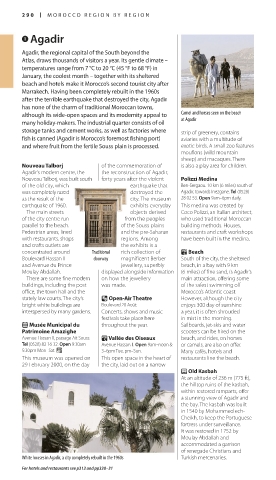
although its wide-open spaces and its modernity appeal to Camel and horses seen on the beach
at Agadir
many holiday-makers. The industrial quarter consists of oil
storage tanks and cement works, as well as factories where strip of greenery, contains
fish is canned (Agadir is Morocco’s foremost fishing port) aviaries with a multitude of
and where fruit from the fertile Souss plain is processed. exotic birds. A small zoo features
mouflons (wild mountain
sheep) and macaques. There
Nouveau Talborj of the commemoration of is also a play area for children.
Agadir’s modern centre, the the reconstruction of Agadir,
Nouveau Talborj, was built south forty years after the violent Polizzi Medina
of the old city, which earthquake that Ben-Sergaou. 10 km (6 miles) south of
was completely razed destroyed the Agadir, towards Inezgane. Tel (0528)
as the result of the city. The museum 28 02 53. Open 9am–6pm daily.
earthquake of 1960. exhibits everyday This medina was created by
The main streets objects derived Coco Polizzi, an Italian architect,
of the city centre run from the peoples who used traditional Moroccan
parallel to the beach. of the Souss plains building methods. Houses,
Pedestrian areas, lined and the pre-Saharan restaurants and craft workshops
with restaurants, shops regions. Among have been built in the medina.
and crafts outlets are the exhibits is a
concentrated around Traditional rich collection of } Beach
Boulevard Hassan II doorway magnificent Berber South of the city, the sheltered
and Avenue du Prince jewellery, superbly beach, in a bay with 9 km
Moulay Abdallah. displayed alongside information (6 miles) of fine sand, is Agadir’s
There are some fine modern on how the jewellery main attraction, offering some
buildings, including the post was made. of the safest swimming off
office, the town hall and the Morocco’s Atlantic coast.
stately law courts. The city’s F Open-Air Theatre However, although the city
bright white buildings are Boulevard 20 Août. enjoys 300 day of sunshine
interspersed by many gardens. Concerts, shows and music a year, it is often shrouded
festivals take place here in mist in the morning.
E Musée Municipal du throughout the year. Sailboards, jet-skis and water
Patrimoine Amazighe scooters can be hired on the
Avenue Hassan II, passage Ait Souss. } Vallée des Oiseaux beach, and rides, on horses
Tel (0528) 82 16 32. Open 9:30am– Avenue Hassan II. Open 9am–noon & or camels, are also on offer.
5:30pm Mon–Sat. & 3–6pm Tue, pm–Sun. Many cafés, hotels and
This museum was opened on This open space in the heart of restaurants line the beach.
29 February 2000, on the day the city, laid out on a narrow
P Old Kasbah
At an altitude of 236 m (775 ft),
the hilltop ruins of the kasbah,
within restored ramparts, offer
a stunning view of Agadir and
the bay. The kasbah was built
in 1540 by Mohammed ech-
Cheikh, to keep the Portuguese
fortress under surveillance.
It was restored in 1752 by
Moulay Abdallah and
accommodated a garrison
of renegade Christians and
White houses in Agadir, a city completely rebuilt in the 1960s Turkish mercenaries.
For hotels and restaurants see p313 and pp330–31
290-291_EW_Morocco.indd 290 09/08/16 11:20 am
Eyewitness Travel LAYERS PRINTED:
Catalogue template “UK” LAYER
(Source v2.7)
Date 1st October 2013
Size 125mm x 217mm

