Page 17 - All About History - Issue 186-19
P. 17
Inside History


          Letting the air out

          At the pinnacle of the kiln’s
          roof was a wooden cowl
          that was connected to the
          building via a sprattle beam.
          The cowl would pivot to
          ensure it always had its back
          to the wind, creating a small       Pulley system
          and controllable vacuum that
          helped to draw the air up and       When hops from the hop
          out of the kiln. It would also      gardens or yards were picked
          shelter the hops from the           they would be placed into
          weather, in particular the rain.    long hessian sacking called
                                              cribs, then transferred to bags
                                              called pokes and brought
                                              into the stowage on the first                                                                                                © Alamy
                                                                                                                                                     Hop drying was
                                              floor. To make life easier for                                                                     expensive, but potentially
                                              the workers, a hoist was often                                                                       profitable for farmers
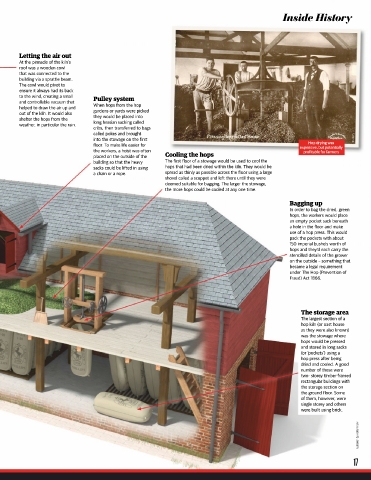
                                              placed on the outside of the      Cooling the hops
                                              building so that the heavy        The first floor of a stowage would be used to cool the
                                              sacks could be lifted in using    hops that had been dried within the kiln. They would be
                                              a chain or a rope.                spread as thinly as possible across the floor using a large
                                                                                shovel called a scuppet and left there until they were
                                                                                deemed suitable for bagging. The larger the stowage,
                                                                                the more hops could be cooled at any one time.

                                                                                                                                            Bagging up

                                                                                                                                            In order to bag the dried, green
                                                                                                                                            hops, the workers would place
                                                                                                                                            an empty pocket sack beneath
                                                                                                                                            a hole in the floor and make
                                                                                                                                            use of a hop press. This would
                                                                                                                                            pack the pockets with about
                                                                                                                                            150 imperial bushels worth of
                                                                                                                                            hops and they’d each carry the
                                                                                                                                            stencilled details of the grower
                                                                                                                                            on the outside – something that
                                                                                                                                            became a legal requirement
                                                                                                                                            under The Hop (Prevention of
                                                                                                                                            Fraud) Act 1866.


                                                                                                                                                 The storage area
                                                                                                                                                 The largest section of a
                                                                                                                                                 hop kiln (or oast house
                                                                                                                                                 as they were also known)
                                                                                                                                                 was the stowage where
                                                                                                                                                 hops would be pressed
                                                                                                                                                 and stored in long sacks
                                                                                                                                                 (or ‘pockets’) using a
                                                                                                                                                 hop press after being
                                                                                                                                                 dried and cooled. A good
                                                                                                                                                 number of these were
                                                                                                                                                 two- storey timber-framed
                                                                                                                                                 rectangular buildings with
                                                                                                                                                 the storage section on
                                                                                                                                                 the ground floor. Some
                                                                                                                                                 of them, however, were
                                                                                                                                                 single storey and others
                                                                                                                                                 were built using brick.


                                                                                                                                                                             Illustration by: Adrian Mann


                                                                                                                                                                           17
   12   13   14   15   16   17   18   19   20   21   22