


Page 16 - All About History - Issue 186-19
P. 16
BEER


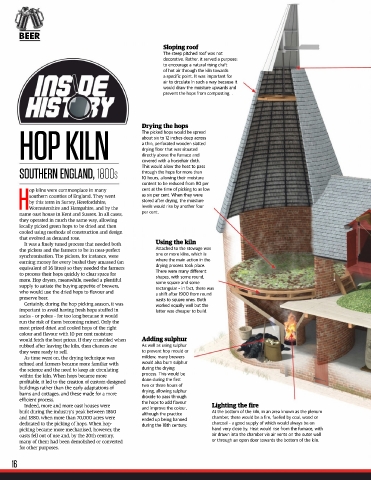
                                                                               Sloping roof
                                                                               The steep pitched roof was not
                                                                               decorative. Rather, it served a purpose:
                                                                               to encourage a natural rising draft
                                                                               of hot air through the kiln towards
                                                                               a specific point. It was important for
                                                                               air to circulate in such a way because it
                                                                               would draw the moisture upwards and
                                                                               prevent the hops from composting. .


          HOP KILN                                                   Drying the hops
                                                                     The picked hops would be spread
                                                                     about six to 12 inches deep across
                                                                     a thin, perforated wooden slatted
                                                                     drying floor that was situated
                                                                     directly above the furnace and
                                                                     covered with a horsehair cloth.
                                                                     This would allow the heat to pass
          SOUTHERN ENGLAND, 1800s                                    through the hops for more than
                                                                     10 hours, allowing their moisture
                                                                     content to be reduced from 80 per
               op kilns were commonplace in many                     cent at the time of picking to as low
               southern counties of England. They went               as six per cent. When they were
               by this term in Surrey, Herefordshire,                stored after drying, the moisture
          HWorcestershire and Hampshire, and by the                  levels would rise by another four
          name oast house in Kent and Sussex. In all cases,          per cent.
          they operated in much the same way, allowing
          locally picked green hops to be dried and then
          cooled using methods of construction and design
          that evolved as demand rose.
             It was a finely tuned process that needed both                 Using the kiln
          the pickers and the farmers to be in near-perfect                 Attached to the stowage was
          synchronisation. The pickers, for instance, were                  one or more kilns, which is
          earning money for every bushel they amassed (an                   where the main action in the
          equivalent of 36 litres) so they needed the farmers               drying process took place.
          to process their hops quickly to clear space for                  There were many different
                                                                            shapes, with some round,
          more. Hop dryers, meanwhile, needed a plentiful                   some square and some
          supply to satiate the buying appetite of brewers,                 rectangular – in fact, there was
          who would use the dried hops to flavour and                       a shift after 1900 from round
          preserve beer.                                                    oasts to square ones. Both
             Certainly, during the hop picking season, it was               worked equally well but the
          important to avoid having fresh hops stuffed in                   latter was cheaper to build.
          sacks – or pokes – for too long because it would
          run the risk of them becoming ruined. Only the
          most prized dried and cooled hops of the right
          colour and flavour with 10 per cent moisture
          would fetch the best prices. If they crumbled when         Adding sulphur
          rubbed after leaving the kiln, then chances are            As well as using sulphur
          they were ready to sell.                                   to prevent hop mould or
             As time went on, the drying technique was               mildew, many brewers
          refined and farmers became more familiar with              would also burn sulphur
          the science and the need to keep air circulating           during the drying
          within the kiln. When hops became more                     process. This would be
          profitable, it led to the creation of custom-designed      done during the first
          buildings rather than the early adaptations of             two or three hours of
          barns and cottages, and these made for a more              drying, allowing sulphur
                                                                     dioxide to pass through
          efficient process.                                         the hops to add flavour
             Indeed, more and more oast houses were                  and improve the colour,           Lighting the fire
          built during the industry’s peak between 1860              although the practice             At the bottom of the kiln, in an area known as the plenum
          and 1880, when more than 70,000 acres were                 ended up being banned             chamber, there would be a fire, fuelled by coal, wood or
          dedicated to the picking of hops. When hop-                during the 18th century.          charcoal – a good supply of which would always be on
          picking became more mechanised, however, the                                                 hand very close by. Heat would rise from the furnace, with
          oasts fell out of use and, by the 20th century,                                              air drawn into the chamber via air vents on the outer wall
          many of them had been demolished or converted                                                or through an open door towards the bottom of the kiln.
          for other purposes.


       16

