


Page 50 - All About History - Issue 186-19
P. 50
e  p                                       They would also implore the saloon owners to           Cleveland, Ohio. Its purpose was to improve every
               g                                                stop selling alcohol, talking about the ills they      aspect of society and its methods were abstinence
          wi    n                                               believed it caused, both physical and moral.           and a drive for purity, symbolised in its emblem
                                                                   Marches in Hillsboro, Ohio, became the              of a white ribbon. It chose a noted social reformer,
                                                                template for a campaign that started in 1874.          Annie Wittenmyer, as its first president and under
          debatedinthesaloo                       u             Men were involved, too, but the public face of         her guidance it soon grew to over 1,000 chapters.
          every village, town and city – buildings from         such campaigns was always female. The image of           From its very earliest days, the WCTU
          which women were banned.                              wives and mothers using peaceful protest to try        demanded a total ban on making and selling

                    “MALEPOLITICIANSACROSSTHEUNITEDSTATESWEREWELLAWARETHATOPPOSINGPROHIBITION

                               AND THEWOMEN WHO WANTED ITCOULD BE FATALFOR THEIRCAREER AMBITIONS”


             In the winter of 1873, a group of female           and change society was a powerful tool that won        alcohol and chose a three-pronged approach.
          campaigners in Ohio decided to target these           publicity as well as some success on the ground.       ‘Agitate, educate, legislate’ became its watchwords,
          saloons as they grew increasingly concerned           By the end of what became known as ‘The                a recipe that it quickly set about putting into
          about the impact of alcohol. They were inspired       Women’s Crusade’, several hundred breweries had        action in its battle against booze.
          by the preaching of Diocletian Lewis, who spoke       shut their doors.                                        Music and theatre became new tools of protest.
          passionately about his mother’s success in shutting      A                                                   Throughout the 1870s and 1880s, an increasing
                                                                   At the same time, a more formal and politically
          a bar through the power of picket and prayer.         minded approach was taking shape with the              number of popular tunes were adopted by female
          Women began to march to saloons, where they           formation of the Women’s Christian Temperance          prohibition campaigners who set new words to
          would stand outside singing hymns and chanting        Union. Set up in December 1873, it officially          them. New compositions also sprung up to spread
          before lobbying customers to change their ways.       opened its doors in 1874 at a convention in            the anti-drink message. Famous songs such as


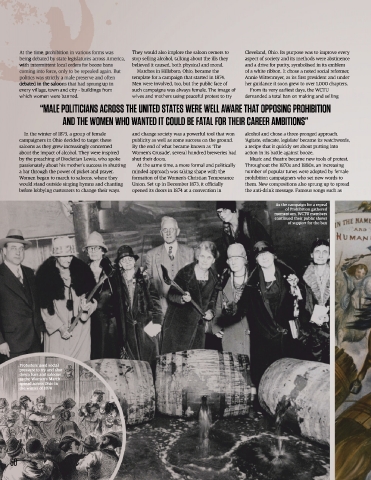
                                                                                                                                     As the campaign for a repeal
                                                                                                                                          of Prohibition gathered
                                                                                                                                     momentum, WCTU members
                                                                                                                                     continued their public shows
                                                                                                                                           of support for the ban


          Protesters used social
          pressure to try and shut
          down bars and saloons
          as the Women’s March
          spread across Ohio in
          the winter of 1874


      50

