Page 52 - All About History - Issue 186-19
P. 52
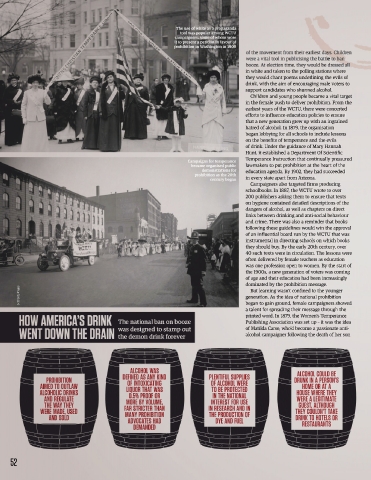
The use of white as a propaganda
                                                                                       tool was popular among WCTU
                                                                                     campaigners, some of whom wore
                                                                                     it to present a petition in favour of
                                                                                     prohibition in Washington in 1909

                                                                                                                                                              e


                                                                                                                       in white and taken to the polling stations where
                                                                                                                       they would chant poems underlining the evils of
                                                                                                                       drink, with the aim of encouraging male voters to
                                                                                                                       support candidates who shunned alcohol.
                                                                                                                         Children and young people became a vital target
                                                                                                                       in the female push to deliver prohibition. From the
                                                                                                                       earliest years of the WCTU, there were concerted
                                                                                                                       efforts to influence education policies to ensure
                                                                                                                       that a new generation grew up with an ingrained
                                                                                                                       hatred of alcohol. In 1879, the organisation
                                                                                                                       began lobbying for all schools to include lessons
                                                                                                                       on the benefits of temperance and the evils
                                                                                                                       of drink. Under the guidance of Mary Hannah
                                                                                                                       Hunt, it established a Department Of Scientific
                                                                                                                       Temperance Instruction that continually pressured
                                                                                           Campaigns for temperance
                                                                                             became organised public   lawmakers to put prohibition at the heart of the
                                                                                                  demonstrations for   education agenda. By 1902, they had succeeded
                                                                                              prohibition as the 20th
                                                                                                      century began    in every state apart from Arizona.
                                                                                                                         Campaigners also targeted firms producing
                                                                                                                       schoolbooks. In 1887, the WCTU wrote to over
                                                                                                                       200 publishers asking them to ensure that texts
                                                                                                                       on hygiene contained detailed descriptions of the
                                                                                                                       dangers of alcohol, as well as chapters on direct
                                                                                                                       links between drinking and anti-social behaviour
                                                                                                                       and crime. There was also a reminder that books
                                                                                                                       following these guidelines would win the approval
                                                                                                                       of an influential board run by the WCTU that was
                                                                                                                       instrumental in directing schools on which books
                                                                                                                       they should buy. By the early 20th century, over
                                                                                                                       40 such texts were in circulation. The lessons were
                                                                                                                       often delivered by female teachers as education
                                                                                                                       was one profession open to women. By the start of
                                                                                                                       the 1900s, a new generation of voters was coming
                                                                                                                       of age and their education had been increasingly
                                                                                                                       dominated by the prohibition message.
          3x © Getty Images                                                                                            generation. As the idea of national prohibition
                                                                                                                         But learning wasn’t confined to the younger


                                                                                                                       began to gain ground, female campaigners showed
                                                                                                                       a talent for spreading their message through the
                                                                                                                       printed word. In 1879, the Women’s Temperance
                                                                        a
                                                             e nat ona ban on booze                                    Publishing Association was set up – it was the idea
                                                                                           e
                                                                    i
                                                          was desi nedd to stamp out                                   of Matilda Carse, who’d become a passionate anti-
                                                          the demon driink forever                                     alcohol campaigner following the death of her son
                                                                    o


                                                               ALCOHOL WAS                                                                     ALCOHOL COULD BE
                            I
                       PROHIBITION                          DEFINED AS ANY KIND                      PLENTIFUL SUPPLIES                       DRUNK IN A PERSON’S
                             B
                           H
                                                              OF INTOXICATING
                                                                                                      OF ALCOHOL WERE
                    AIMED TO OUTLAW                           LIQUOR THAT WAS                         T TO BE PROTECTED                           HOME OR AT A
                              O
                                                                                                        O
                    ALCOHOLIC DRINKS                           0.5% PROOF OR                           IN THE NATIONAL                         HOUSE W ERE THEY
                               D
                                                                                                           H
                                                                                                          T
                                                                                                        N
                      AND REGULATE                           MORE BY VOLUME,                          INTEREST FOR USE                         WERE A LEGITIMATE
                                 A
                                                                                                             S
                                                                                                            E
                                  E
                                   Y
                      THEWAY THEY                            FAR STRICTER THAN                       IN RESEARCH AND IN                         GUEST, ALTHOUGH
                                                                                                                H
                                                                                                               C
                    WERE MADE, USED                          MANY PROHIBITION                        THE PRODUCTION OF                         THEY COULDN’T TAKE
                                    E
                                                                                                                    N
                                                                                                                   O
                        AND SOLD                              ADVOCATES HAD                             DYE AND FUEL                           DRINK TO HOTELS OR
                                                                 DEMANDED                                                                         RESTAURANTS
      52
   47   48   49   50   51   52   53   54   55   56   57