


Page 53 - All About History - Issue 186-19
P. 53
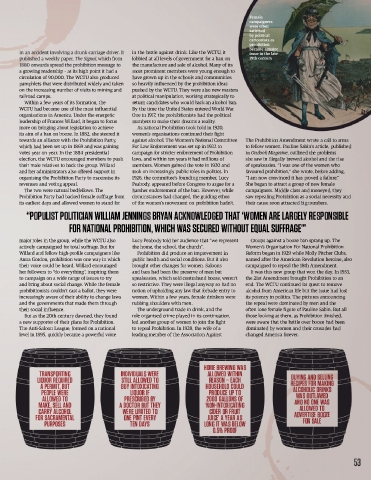
Female
                                                                                                                         campaigners
                                                                                                                         were often
                                                                                                                         satirized
                                                                                                                         by political
                                                                                                                         cartoonists as
                                                                                                                         prohibition
                                                                                                                         became a major
                                                                in t e att e a ainst rin . Li e t e WCTU, it             issue in the late
                                                which from      lobbied at all levels o government or a ban on           19th century
                                                                 he manufacture and sale of alcohol. Many of its
          a growing readership – at its high point it had a       ost prominent mem ers were young enoug to
          circulation of 90,000. The WCTU also roduced            ave grown up in t e sc oo s an communities
            am hlets that were distributed widel and taken      so heavily in luenced by the prohibition ideas
          on the increasing number of visits to mining and      pus e     y t e WCTU. T ey were a so new masters
          railroad cam s                                        at po itica manipu ation, wor ing strategica y to
               ithin a few ears of its formation, the            eturn can i ates w o wou       ac an a co o    an.
          WCT       d bec me ne f the m t influenti l           By t e time t e Unite States entere Wor      War
          organisations in America. Under the energetic         One in 1917, t e pro i itionists a    e po itica
           eadership of Frances Willard, it be an to focus        um ers to ma e t eir reams a rea ity.
          more on ringing a out egis ation to ac ieve                 nationa Pro i ition too    o  in 1920,
          its aim of a ban on booze. In 1882, she steered it    women’s organisations continued their fight
          towar s an a iance wit      e Pro i ition Part ,      a ainst a co o . T e Women’s Nationa Committee         The Pr hibit n Amendment wr te         ll    rm
          w ic    a    een set up in 1869 an was gaining        For Law En orcement was set up in 1922 to              to fellow women. Pauline Sabin’s article, ublishe
          votes ear on ear. In t e 1884 resi entia              campai n or stricter en orcement o Prohibition         i Ou oo Ma azine out ine        e ro ems
          e ection, t e WCTU encourage mem ers to pus           laws, and within ten years it had millions o           s e saw in i ega y rewe      co o an     e ri
          t eir ma e re atives to ac    e roup. Wi a              em ers. Women gaine        e vote in 1920 an         of s eakeasies. ‘’I was one of the women who
          and her administrators also offered support in         ook on increasin ly public roles in politics. In       avoured prohibition,’’ she wrote, be ore adding,
          organising t e Pro i ition Party to maximise its      1926, the committee’s oundin member, Lucy              ’’I am now convinced it has   oved a failure.’’
          revenues an votin appea .                             Peabody, appeared before Con ress to ar ue for a       She began to attract a group of new female
              he two were natural bed ellows. The                 arsher endorsement of the ban. Howeve while          campaigners. M     e c ass an moneye , t ey
          Prohibition Party had backed female suffra e from     circumstances had changed, the guiding ethos           saw repea in Pro i ition as a socia necessity an
          its earliest days and allowed women to stand or       o the women’s movement on rohibition hadn’t.           t eir cause soon attracte  i num ers.

              “P P LI TP LITI IANWILLIAMJENNIN BRYANA KN WLED EDTHAT‘W MENARELAR ELYRE P N IBLE

                                  FOR NATIONAL PROHIBITION WHICH WAS SECURED WITHOUT EQUAL SUFFRAGE’”


          major roles in the group, while the WCTU also         Luc Pea o      to    er au ience t at ‘’we re resent       roups against a booze ban sprang up. The
          actively campai ned or total su ra e. But or           he home, the school, the church’                      Women’s Or anisation For National Prohibition
          Willard and fellow hi h-profile campai ners like           o i ition i    ro uce an im ovement                eform be an in 1929 while Molly Pitcher Clubs,
            nna Gordon, rohibition was one wa in which            u ic ea t an socia con itions. But it a so           named after the American Revolution heroine also
          their voice could be heard. Willard encoura ed        brought other changes for women. Saloons               campai ned to repeal the 18th Amendment.
          her followers to “do everything”, inspiring them      and bars had been the reserve of men but                   was this new roup that won the day. In 1933,
          to campai n on a wide ran e of issues to try          s ea easies, w ic so     contra an    ooze, weren’t    the 21st Amendment brou ht Prohibition to an
          and bring about social change. While the female       so restrictive. T ey were i e a anyway so a no         end. The WCTU continued its uest to remove
            rohibitionists couldn’t cast a ballot, the were     notion o upholding any law that orbade entry to         lc h l fr m Americ n life but the i ue h d l t
          increasingly aware o their ability to change laws     women. Within a few ears, female drinkers were         its potency in politics. The pictures announcin
          and the overnments that made them throu h             ru   ing s ou ers wit men                              t e repea were ominate       y men an     e
          their social in luence                                    he underground trade in drink, and the             often lone female fi ure of Pauline Sabin. But all
              ut as the 20th centur dawned, the     ound        role or anised crime played in its continuation,       those looking at them, as Prohibition inished,
          a new su    orter of their lans for Prohibition.      led another group of women to join the fight           were aware t at t e att e over ooze a       een
          The Anti-Saloon Lea ue, ormed on a national           to r  eal Prohibition. In 1928, the wi e o a            ominate      women an       eir crusa es a
          level in 1895, uick  became a owerful voice           leadin  member of the Association A ainst              chan ed America orever.


                                                                                                     ME BREWIN WA
                    TRAN P RTIN                            INDIVID AL WERE                            LL WED WITHIN
                   LI UOR RE UIRED                          TILL ALL WED T                            EASON – EACH
                      PERMI BUT                            BUY INTOXICATIN                          HOUSEHOLD COULD
                     PE PLE WERE                               LIQUOR IF                             PR D E P T                                  A     TLAWED
                     ALL WED T                               PRE RIB      Y                         2000 GALLONS OF                            N NO ONE WAS
                   MAKE SELL AND                            DOCTO      T THEY                       N N-INT XI ATIN                               LLOWED TO
                     ARRY AL H L                              E    IMITED T                            IDER R FR IT                              VERTI E     ZE
                  FOR SACRAMENTAL                              E PINT EVERY                         JUI E’ A YEAR A                                 R ALE
                      PURPOSES                                 TEN DAYS                              N IT WA BEL W
                                                                                                        .         F

