


Page 49 - All About History - Issue 186-19
P. 49
A century ago America banned booze, with women


                                            leading the charge for and against Prohibition


                                                                             Written by June Woolerton


                     hen America went dry in 1920, the          of Andrew Volstead, the Republican politician          weak and more prone to accident, injury or worse.
                     newspapers were filled with images         who sponsored it. Both men had grown up in             The dangers posed to their children, of growing
                     of the men in high office who had          a world where female prohibition campaigners           up in poverty, were underlined in sermons and
                     ordered Prohibition into being and         had influenced education, scientific thought and       pamphlets. Women were told their role was
                     the male enforcement officers who          media debate. They, like millions of other men of      as the moral guardian of their home and their
          were smashing booze into history. But behind          voting age, had been brought up on the message         community, and it was a message an increasing
          this masculine façade lay a reality few could deny.   that booze was bad. And male politicians across        number took to heart.
          Prohibition, one of the biggest social changes in the  the United States were well aware that opposing         In 1853, the first Women’s Temperance
          Western world in decades, was down to women.          prohibition and the women who wanted it could          Convention was held in Ohio, an area that would
             Through social pressure, protests and relentless   be fatal for their career ambitions.                   become a focal point in the push for prohibition.
          campaigning, female prohibitionists had turned           This overarching influence was a long way from
          the religious push for temperance that grew           the origins of the large-scale organised female
          steadily in 19th century American communities         opposition to alcohol. As early as 1831, there had
          into the dominant political issue of the early 20th   been 24 women’s groups in America campaigning
          century. It didn’t matter that they couldn’t vote.    for temperance, but often these early crusaders
          The populist politician William Jennings Bryan        wanted to control how much people drank rather
          acknowledged that ‘’women are largely responsible     than stop them imbibing altogether. Those first
          for national Prohibition, which was secured           crusaders were giving voice to an increasing belief
          without equal suffrage’’.                             in local communities, especially rural, that drink
             With no official political voice for women,        was to blame for many of society’s problems.
          the final push for a booze ban came from men.         Wives and mothers were targeted by ministers,
          It was Wayne Wheeler, the famously ambitious          especially in fledgling Protestant churches, with
          leader of the Anti-Saloon League, who helped          the message that alcohol was draining money and
          draft the Act covering the legislation required to    morals from their family homes.
          implement the 18th Amendment, which banned               With no employment opportunities of their
          the ‘’manufacture, sale or transportation of          own, women were warned that alcohol threatened
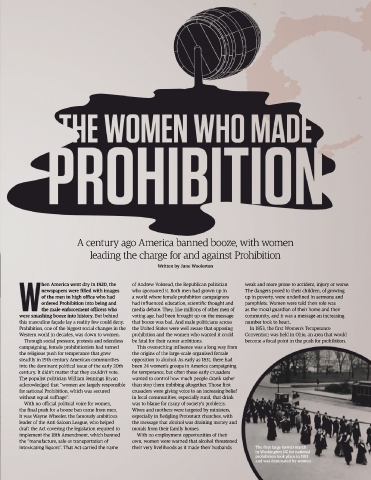
          intoxicating liquors’’. That Act carried the name     their very livelihoods as it made their husbands            The first large formal march
                                                                                                                            in Washington DC for national
                                                                                                                            prohibition took place in 1913
                                                                                                                            and was dominated by women

