


Page 35 - (DK Eyewitness) Travel Guide - Germany
P. 35
A POR TR AIT OF GERM AN Y 33
Beethoven (1770–1827) was whose “Wedding March” from
born in Bonn, although he A Midsummer Night’s Dream
worked mainly in Vienna. accompanies wedding
Among his best-known celebrations around the
works are his nine world. As well as this,
symphonies, as well as however, Mendelssohn’s
piano and violin legacy includes five
concertos, two symphonies, piano
masses, various music, chamber
chamber works and music and oratorios.
the opera Fidelio. In 1843, he founded
The life of this great Germany’s first music
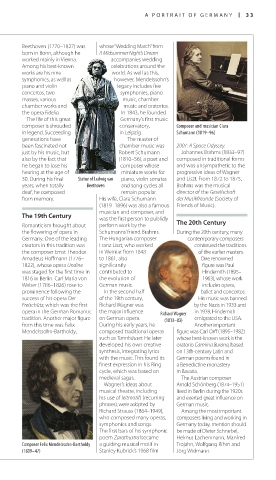
composer is shrouded conser vatory, Composer and musician Clara
in legend. Succeeding in Leipzig. Schumann (1819–96)
gener ations have The master of
been fascinated not chamber music was 2001: A Space Odyssey.
just by his music, but Robert Schumann Johannes Brahms (1833–97)
also by the fact that (1810–56), a poet and composed in traditional forms
he began to lose his composer whose and was unsympathetic to the
hearing at the age of miniature works for progressive ideas of Wagner
30. During his final Statue of Ludwig van piano, violin sonatas and Liszt. From 1872 to 1875,
years, when totally Beethoven and song cycles all Brahms was the musical
deaf, he composed remain popular. director of the Gesellschaft
from memory. His wife, Clara Schumann der Musikfreunde (Society of
(1819–1896) was also a famous Friends of Music).
musician and composer, and
The 19th Century was the first person to publicly
Romanticism brought about perform work by the The 20th Century
the flowering of opera in Schumanns’ friend Brahms. During the 20th century, many
Germany. One of the leading The Hungarian composer contemporary composers
creators in this tradition was Franz Liszt, who worked continued the traditions
the composer Ernst Theodor in Weimar from 1848 of the earlier masters.
Amadeus Hoffmann (1776– to 1861, also One renowned
1822), whose opera Undine significantly figure was Paul
was staged for the first time in contributed to Hindemith (1895–
1816 in Berlin. Carl Maria von the evolution of 1963), whose work
Weber (1786–1826) rose to German music. includes opera,
prominence following the In the second half ballet and concertos.
success of his opera Der of the 19th century, His music was banned
Freischütz, which was the first Richard Wagner was by the Nazis in 1933 and
opera in the German Romantic the major influence Richard Wagner in 1939, Hindemith
tradition. Another major figure on German opera. (1813–83) emigrated to the USA.
from this time was Felix During his early years, he Another important
Mendelssohn-Bartholdy, composed traditional operas figure was Carl Orff (1895–1982)
such as Tannhäuser. He later whose best-known work is the
developed his own creative oratorio Carmina Burana, based
synthesis, integrating lyrics on 13th-century Latin and
with the music. This found its German poems found in
finest expression in his Ring a Benedictine monastery
cycle, which was based on in Bavaria.
medieval sagas. The Austrian composer
Wagner’s ideas about Arnold Schönberg (1874–1951)
musical theatre, including lived in Berlin during the 1920s
his use of leitmotifs (recurring and exerted great influence on
phrases), were adopted by German music.
Richard Strauss (1864–1949), Among the most important
who composed many operas, composers living and working in
symphonies and songs. Germany today, mention should
The first bars of his symphonic be made of Dieter Schnebel,
poem Zarathustra became Helmut Lachenmann, Manfred
Composer Felix Mendelssohn-Bartholdy a guiding musical motif in Trojahn, Wolfgang Rihm and
(1809–47) Stanley Kubrick’s 1968 film Jörg Widmann.
032-033_EW_Germany.indd 33 09/10/17 12:46 pm

