


Page 42 - (DK Eyewitness) Travel Guide - Germany
P. 42
40 INTRODUCING GERM AN Y A POR TR AIT OF GERM AN Y 41
German Beer How Beer is Brewed
The method of brewing beer that is now virtually standard dates
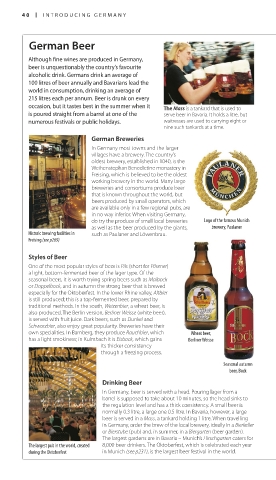
Although fine wines are produced in Germany, from the 19th century, when Czech brewers first produced
beer is unquestionably the country’s favourite bottom-fermented beers at lower temperatures.
alcoholic drink. Germans drink an average of The method was perfected by Gabriel Sedlmayr.
100 litres of beer annually and Bavarians lead the Each brewery has its secrets, but the initial
stages of production are the same.
world in consumption, drinking an average of
215 litres each per annum. Beer is drunk on every
occasion, but it tastes best in the summer when it The Mass is a tankard that is used to Mashing vat A climbing plant, hops are trained to grow up
is poured straight from a barrel at one of the serve beer in Bavaria. It holds a litre, but special supports
numerous festivals or public holidays. waitresses are used to carrying eight or
nine such tankards at a time.
The main ingredients in the
German Breweries 1production of beer are barley,
In Germany most towns and the larger hops and crystal-clear water.
villages have a brewery. The country’s Other grains, including wheat
and rice, can also be used – for
oldest brewery, established in 1040, is the Barley and example Weizenbier is made
Weihenstephan Benedictine monastery in hops from wheat rather than barley.
Freising, which is believed to be the oldest The first stage of brewing is
working brewery in the world. Many large malting, when the grains are
breweries and consortiums produce beer soaked and left to germinate.
that is known throughout the world, but After a few days, these are
beers produced by small operators, which The milled barley is mixed with warm dried and then milled.
are available only in a few regional pubs, are 2water and placed in a copper mashing vat.
in no way inferior. When visiting Germany, During the mashing process, the starches
do try the produce of small local breweries Logo of the famous Munich in the grain turn into fermentable sugars. The wort is put into a copper
as well as the beer produced by the giants, brewery, Paulaner The mash is then filtered to separate out a 3vessel with the hops and
Historic brewing facilities in such as Paulaner and Löwenbrau. liquid, known as the wort, from the mash. then cooked. Depending on
Freising (see p269) the amount of hops added,
the beer will be more
The wort is filtered again, cooled or less bitter. Traditionally
Styles of Beer 4and combined with yeast. the hops are added to
One of the most popular styles of beer is Pils (short for Pilsener) Fermentation then takes place. the vessel by hand, in
a light, bottom-fermented beer of the lager type. Of the At temperatures above 20° C carefully measured
seasonal beers, it is worth trying spring beers such as Maibock (68° F), the liquid reaches “top proportions. Some-
or Doppelbock, and in autumn the strong beer that is brewed fermentation”, which takes 3–5 times, however,
days. “Bottom fermentation”, where
they are added, as
especially for the Oktoberfest. In the lower Rhine valley, Altbier the temperature is below 12° C required, during
is still produced; this is a top-fermented beer, prepared by (54° F), takes 7–10 days. the cooking process.
traditional methods. In the south, Weizenbier, a wheat beer, is
also produced. The Berlin version, Berliner Weisse (white beer),
is served with fruit juice. Dark beers, such as Dunkel and The young beer produced by fermentation is
Schwarzbier, also enjoy great popularity. Breweries have their 5left to rest in special containers that enable a
own specialities. In Bamberg, they produce Rauchbier, which Wheat beer, higher pressure to be maintained. During this
has a light smokiness; in Kulmbach it is Eisbock, which gains Berliner Weisse resting stage, which can last from a couple
its thicker consistency of weeks to a year or even longer, the beer
through a freezing process. matures. The effect of resting the beer is to
make it stronger. Resting takes place in metal
Seasonal autumn or traditional wooden barrels.
beer, Bock
Drinking Beer
In Germany, beer is served with a head. Pouring lager from a
The mature beer,
barrel is supposed to take about 10 minutes, so the head sinks to 6which is ready to
the regulation level and has a thick consistency. A small beer is be sold, is then
normally 0.3 litre, a large one 0.5 litre. In Bavaria, however, a large transferred to
beer is served in a Mass, a tankard holding 1 litre. When travelling bottles or cans and
in Germany, order the brew of the local brewery, ideally in a Bierkeller pasteurized. This
or Bierstube (pub) and, in summer, in a Biergarten (beer garden). process removes
The largest gardens are in Bavaria – Munich’s Hirschgarten caters for micro-organisms
The largest pub in the world, created 8,000 beer drinkers. The Oktoberfest, which is celebrated each year that threaten the Traditional wooden barrels
during the Oktoberfest in Munich (see p231), is the largest beer festival in the world. quality of the beer. containing resting beer
040-041_EW_Germany.indd 40 09/10/17 12:53 pm 040-041_EW_Germany.indd 41 09/10/17 12:53 pm
Eyewitness Travel LAYERS PRINTED:
Feature template “UK” LAYER
(SourceReport v1.3)
Date 18th October 2012
Size 125mm x 217mm

