


Page 43 - (DK Eyewitness) Travel Guide - Germany
P. 43
A POR TR AIT OF GERM AN Y 41
How Beer is Brewed
The method of brewing beer that is now virtually standard dates
from the 19th century, when Czech brewers first produced
bottom-fermented beers at lower temperatures.
The method was perfected by Gabriel Sedlmayr.
Each brewery has its secrets, but the initial
stages of production are the same.
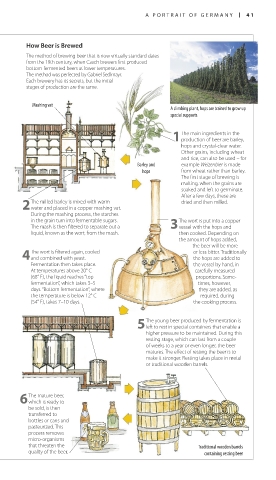
Mashing vat
A climbing plant, hops are trained to grow up
special supports
The main ingredients in the
1production of beer are barley,
hops and crystal-clear water.
Other grains, including wheat
and rice, can also be used – for
Barley and example Weizenbier is made
hops from wheat rather than barley.
The first stage of brewing is
malting, when the grains are
soaked and left to germinate.
After a few days, these are
The milled barley is mixed with warm dried and then milled.
2water and placed in a copper mashing vat.
During the mashing process, the starches
in the grain turn into fermentable sugars. The wort is put into a copper
The mash is then filtered to separate out a 3vessel with the hops and
liquid, known as the wort, from the mash. then cooked. Depending on
the amount of hops added,
the beer will be more
The wort is filtered again, cooled or less bitter. Traditionally
4and combined with yeast. the hops are added to
Fermentation then takes place. the vessel by hand, in
At temperatures above 20° C carefully measured
(68° F), the liquid reaches “top proportions. Some-
fermentation”, which takes 3–5 times, however,
days. “Bottom fermentation”, where they are added, as
the temperature is below 12° C required, during
(54° F), takes 7–10 days. the cooking process.
The young beer produced by fermentation is
5left to rest in special containers that enable a
higher pressure to be maintained. During this
resting stage, which can last from a couple
of weeks to a year or even longer, the beer
matures. The effect of resting the beer is to
make it stronger. Resting takes place in metal
or traditional wooden barrels.
The mature beer,
6which is ready to
be sold, is then
transferred to
bottles or cans and
pasteurized. This
process removes
micro-organisms
that threaten the Traditional wooden barrels
quality of the beer. containing resting beer
040-041_EW_Germany.indd 41 09/10/17 12:53 pm

