


Page 76 - All About History - Issue 16-14
P. 76
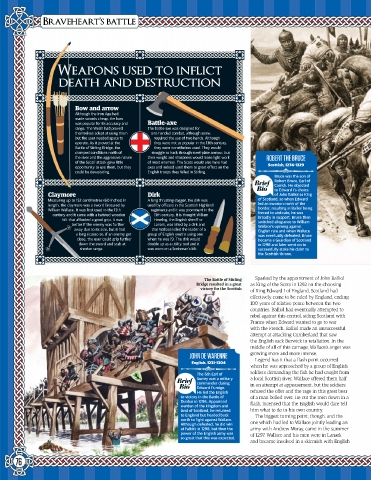
Braveheart’s battle


                     Weapons used to inflict
                      death and destruction


                           Bow and arrow
                           Although the Iron Age had
                           made swords cheap, the bow
                           was popular for its accuracy and   Battle-axe
                           range. The Welsh had proved   The battle-axe was designed for
                           themselves adept at using them   one-handed combat, although some
                           but the user needed space to   required the use of two hands. Although
                           operate. As it proved at the   they were not as popular in the 13th century,
                           Battle of Stirling Bridge, the   they were nonetheless used. They would
                           cramped conditions north of   struggle to hack through steel-plate armour, but
                           the river and the aggressive nature   their weight and sharpness would make light work   ROBERT THE BRUCE
                           of the Scots’ attack gave little   of most enemies. The Scots would also have had
                           opportunity to use them, but they   axes and indeed used them to great effect on the   Scottish, 1274-1329
                           could be devastating.     English troops they felled in Stirling.
                                                                                                 Bruce was the son of
                                                                                           Brief   Robert Bruce, Earl of
                                                                                                 Carrick. He objected
                                                                                           Bio   to Edward I’s choice
                  Claymore                           Dirk                                        of John Balliol as King
                  Measuring up to 152 centimetres (60 inches) in   A long thrusting dagger, the dirk was   of Scotland, so when Edward
                  length, the claymore was a sword favoured by   used by officers in the Scottish Highland   led an invasion north of the
                  William Wallace. It was first used in the 13th   regiments and it was prominent in the   border, resulting in Balliol being
                                                                                            forced to abdicate, he was
                    century and it came with a twisted wooden   13th century. It is thought William   broadly in support. Bruce then
                       hilt that afforded a good grip. It was   Heselrig, the English sheriff or   switched allegiance to William
                          better if the enemy was further   Lanark, was killed by a dirk and   Wallace’s uprising against
                           away due to its size, but it had   that Wallace killed the leader of a   English rule and when Wallace
                            a long ricasso so, if an enemy got   group of English youths using one   was eventually defeated, Bruce
                            close, the user could grip further   when he was 19. The dirk would   became a Guardian of Scotland
                             down the sword and stab at   double up as a utility tool and it   in 1298 and later went on to
                             shorter range.          was worn on a Scotsman’s kilt.         successfully stake his claim to
                                                                                            the Scottish throne.


                                                                         The Battle of Stirling   Sparked by the appointment of John Balliol
                                                                      Bridge resulted in a great   as King of the Scots in 1292 on the choosing
                                                                       victory for the Scottish
                                                                                         of King Edward I of England, Scotland had
                                                                                         effectively come to be ruled by England, ending
                                                                                         100 years of relative peace between the two
                                                                                         countries. Balliol had eventually attempted to
                                                                                         rebel against this control, siding Scotland with
                                                                                         France when Edward wanted to go to war
                                                                                         with the French. Balliol made an unsuccessful
                                                                                         attempt at attacking Cumberland that saw
                                                                                         the English sack Berwick in retaliation. In the
                                                                                         middle of all of this carnage, Wallace’s anger was
                                                                    JOHN DE WARENNE      growing more and more intense.
                                                                    English, 1231-1304     Legend has it that a flash point occurred
                                                                                         when he was approached by a group of English
                                                                                         soldiers demanding the fish he had caught from
                                                                      The 6th Earl of
                                                               Brief   Surrey was a military   a local Scottish river. Wallace offered them half
                                                                      commander during
                                                                Bio   Edward I’s reign.   in an attempt at appeasement, but the soldiers
                                                                      He led the English   refused the offer and the rage in this great bear
                                                                 to victory in the Battle of   of a man boiled over. He cut the men down in a
                                                                 Dunbar in 1296. Appointed
                                                                 warden of the kingdom and   flash, incensed that the English would dare tell
                                                                 land of Scotland, he returned   him what to do in his own country.
                                                                 to England but headed back   The biggest turning point, though, and the
                                                                 north to fight against Wallace.
                                                                 Although defeated, he did win   one which had led to Wallace jointly leading an
                                                                 at Falkirk in 1298, but then the   army with Andrew Moray, came in the summer
                                                                 power of the English army was   of 1297. Wallace and his men were in Lanark
                                                                 so great that this was expected.
                                                                                         and became involved in a skirmish with English

       76

