


Page 77 - All About History - Issue 16-14
P. 77
Braveheart’s battle


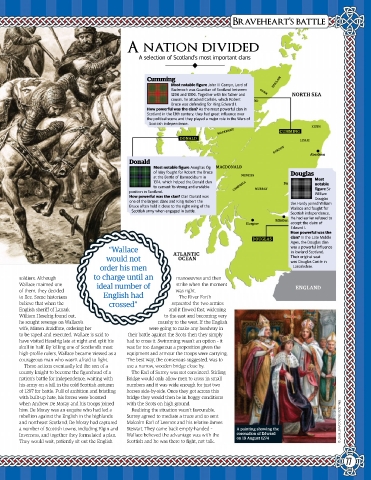
                                              A nation divided

                                                  A selection of Scotland’s most important clans


                                                     Cumming                                     SINCLAIR
                                                             Most notable figure John III Comyn, Lord of
                                                             Badenoch was Guardian of Scotland between   GUNN

                                                             1296 and 1306. Together with his father and   NORTH SEA
                                                             cousin, he attacked Carlisle, which Robert   ND
                                                             Bruce was defending for King Edward I.
                                                     How powerful was the clan? As the most powerful clan in

                                                     Scotland in the 13th century, they had great influence over
                                                     the political scene and they played a major role in the Wars of
                                                     Scottish Independence.
                                                                                                               KEITH
                                                                              MACKENZIE            CUMMING
                                                                DONALD
                                                                                                          LESLIE
                                                                                                 GORDON
                                                                                                              Aberdeen
                                              Donald
                                                       Most notable figure Aonghas Óg   MACDONALD
                                                       of Islay fought for Robert the Bruce            Douglas
                                                                                      MENZIES
                                                       at the Battle of Bannockburn in                          Most
                                                       1314, which helped the Donald clan            Du         notable
                                                       to cement its strong and enviable   CAMPBELL
                                              position in Scotland.                        MURRAY               figure Sir
                                                                                                                William
                                              How powerful was the clan? Clan Donald was                        Douglas
                                              one of the largest clans and King Robert the
                                                                                                       the Hardy joined William
                                              Bruce often held it close to the right wing of the       Wallace and fought for
                                               Scottish army when engaged in battle.
                                                                                                       Scottish independence.
                                                                                                       He had earlier refused to
                                                                                                  Edinbur
                                                                                       Glasgow         accept the claim of
                                                                                                       Edward I.
                                                                                                       How powerful was the
                                                                                          DOUGLAS      clan? In the Late Middle
                                                                                                       Ages, the Douglas clan
                                       “Wallace                                                        was a powerful influence
                                                                                                       in lowland Scotland.
                                                              ATLANTIC
                                      would not                 OCEAN                                  Their original seat
                                                                                                       was Douglas Castle in
                                    order his men                                                       Lanarkshire.
        soldiers. Although        to charge until an           manoeuvres and then
        Wallace maimed one         ideal number of             strike when the moment                    ENGLAND
        of them, they decided                                  was right.
        to flee. Some historians     English had                The River Forth
        believe that when the          crossed”              separated the two armies
        English sheriff of Lanark                           and it flowed fast, widening
        William Heselrig found out,                        to the east and becoming very
        he sought revenge on Wallace’s                   marshy to the west. If the English
        wife, Mirren Braidfute, ordering her         were going to make any headway in
        to be raped and executed. Wallace is said to   their battle against the Scots then they simply
        have visited Heselrig late at night and split his   had to cross it. Swimming wasn’t an option – it
        skull in half. By killing one of Scotland’s most   was far too dangerous a proposition given the
        high-profile rulers, Wallace became viewed as a   equipment and armour the troops were carrying.
        courageous man who wasn’t afraid to fight.   The best way, the consensus suggested, was to
          These actions eventually led the son of a   use a narrow, wooden bridge close by.
        county knight to become the figurehead of a   The Earl of Surrey was not convinced. Stirling
        nation’s battle for independence, waiting with   Bridge would only allow men to cross in small
        his army on a hill in the cold Scottish autumn   numbers and it was wide enough for just two
        of 1297 for battle. Full of ambition and bristling   horses side-by-side. Once they got across this
        with built-up hate, his forces were boosted   bridge they would then be in boggy conditions
        when Andrew De Moray and his troops joined   with the Scots on high ground.
        him. De Moray was an esquire who had led a   Realising the situation wasn’t favourable,
        rebellion against the English in the highlands   Surrey agreed to mediate a truce and so sent
        and northeast Scotland. De Moray had captured   Malcolm Earl of Lennox and his relative James                    © Look & Learn/Corbis/Free Vector Maps
        a number of Scottish towns, including Elgin and   Stewart. They came back empty-handed –   A painting showing the
        Inverness, and together they formulated a plan.   Wallace believed the advantage was with the   coronation of Edward
                                                                                    on 19 August 1274
        They would wait, patiently sit out the English   Scottish and he was there to fight, not talk.

                                                                                                                           77

