


Page 162 - Ultimate Visual Dictionary (DK)
P. 162
PLANTS

       Carnivorous                                       Areola              PITCHER PLANT
                                                                             Cobra lily (Darlingtonia californica)
                                                         (“window” of
                                                         transparent tissue)
                                                                                    Hood         Pitcher
                                                         Fishtail nectary
       plants                                                   Wing                             Tubular
                                                                                                 petiole
                                                                                                 (leaf stalk)
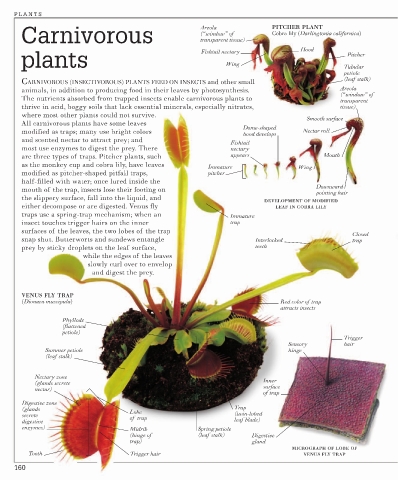
       CARNIVOROUS (INSECTIVOROUS) PLANTS FEED ON INSECTS and other small
       animals, in addition to producing food in their leaves by photosynthesis.               Areola
                                                                                               (“window” of
       The nutrients absorbed from trapped insects enable carnivorous plants to                transparent
       thrive in acid, boggy soils that lack essential minerals, especially nitrates,          tissue)
       where most other plants could not survive.
                                                                                      Smooth surface
       All carnivorous plants have some leaves
                                                                     Dome-shaped
       modified as traps; many use bright colors                     hood develops   Nectar roll
       and scented nectar to attract prey; and
                                                                 Fishtail
       most use enzymes to digest the prey. There                nectary
       are three types of traps. Pitcher plants, such            appears                   Mouth
       as the monkey cup and cobra lily, have leaves       Immature                 Wing
       modified as pitcher-shaped pitfall traps,           pitcher
       half-filled with water; once lured inside the
                                                                                         Downward
       mouth of the trap, insects lose their footing on
                                                                                         pointing hair
       the slippery surface, fall into the liquid, and
                                                                          DEVELOPMENT OF MODIFIED
       either decompose or are digested. Venus fly                            LEAF IN COBRA LILY
       traps use a spring-trap mechanism; when an                Immature
       insect touches trigger hairs on the inner                 trap
       surfaces of the leaves, the two lobes of the trap
                                                                                                   Closed
       snap shut. Butterworts and sundews entangle                      Interlocked                trap
       prey by sticky droplets on the leaf surface,                     teeth
                        while the edges of the leaves
                         slowly curl over to envelop
                           and digest the prey.


       VENUS FLY TRAP
       (Dionaea muscipula)                                                     Red color of trap
                                                                               attracts insects
                  Phyllode
                  (flattened
                  petiole)
                                                                                                 Trigger
                                                                                 Sensory         hair
              Summer petiole                                                     hinge
              (leaf stalk)

           Nectary zone
           (glands secrete                                                Inner
           nectar)                                                        surface
                                                                          of trap
       Digestive zone
       (glands                       Lobe                         Trap
       secrete                       of  trap                     (twin-lobed
       digestive                                                  leaf blade)
       enzymes)                      Midrib             Spring petiole
                                     (hinge of          (leaf stalk)   Digestive
                                     trap)                             gland
                                                                                  MICROGRAPH OF LOBE OF
         Tooth                       Trigger hair                                    VENUS FLY TRAP
     160

