


Page 160 - Ultimate Visual Dictionary (DK)
P. 160
PLANTS

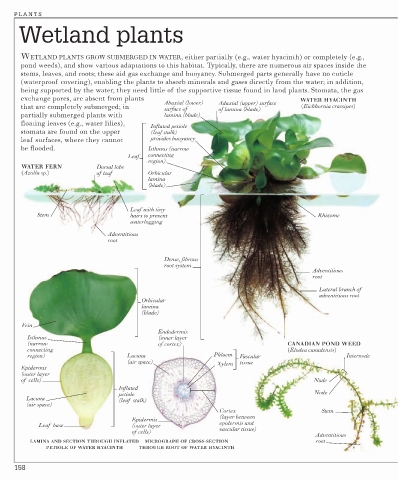
      Wetland plants


       WETLAND PLANTS GROW SUBMERGED IN WATER, either partially (e.g., water hyacinth) or completely (e.g.,
       pond weeds), and show various adaptations to this habitat. Typically, there are numerous air spaces inside the
       stems, leaves, and roots; these aid gas exchange and buoyancy. Submerged parts generally have no cuticle
       (waterproof covering), enabling the plants to absorb minerals and gases directly from the water; in addition,
       being supported by the water, they need little of the supportive tissue found in land plants. Stomata, the gas
       exchange pores, are absent from plants                                       WATER HYACINTH
                                               Abaxial (lower)   Adaxial (upper) surface
       that are completely submerged; in       surface of     of  lamina (blade)     (Eichhornia crassipes)
       partially submerged plants with         lamina (blade)
       floating leaves (e.g., water lilies),
                                           Inflated petiole
       stomata are found on the upper      (leaf stalk)
       leaf surfaces, where they cannot    provides buoyancy
       be flooded.                        Isthmus (narrow
                                     Leaf  connecting
                                          region)
       WATER FERN           Dorsal lobe
       (Azolla sp.)         of leaf       Orbicular
                                          lamina
                                          (blade)


                                     Leaf with tiny
           Stem                      hairs to prevent                                    Rhizome
                                     waterlogging
                               Adventitious
                               root


                                               Dense, fibrous
                                               root system
                                                                                        Adventitious
                                                                                        root
                                                                                          Lateral branch of
                                                                                          adventitious root
                                        Orbicular
                                        lamina
                                        (blade)
       Vein
                                             Endodermis
         Isthmus                             (inner layer
         (narrow                             of cortex)                          CANADIAN POND WEED
         connecting                                                              (Elodea canadensis)
         region)                    Lacuna                  Phloem  Vascular                     Internode
                                    (air space)              Xylem  tissue
       Epidermis
       (outer layer
       of  cells)                                                                       Node
                                  Inflated
                                  petiole                                               Node
        Lacuna
                                  (leaf  stalk)
        (air space)
                                                              Cortex                      Stem
                                                              (layer between
                                      Epidermis
            Leaf  base                (outer layer            epidermis and
                                      of cells)               vascular tissue)
                                                                                         Adventitious
         LAMINA AND SECTION THROUGH INFLATED   MICROGRAPH OF CROSS-SECTION               root
              PETIOLE OF WATER HYACINTH  THROUGH ROOT OF WATER HYACINTH
     158

