


Page 158 - Ultimate Visual Dictionary (DK)
P. 158
PLANTS

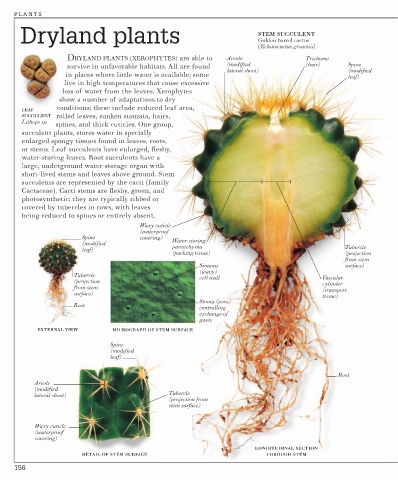
       Dryland plants                                                    STEM SUCCULENT
                                                                         Golden barrel cactus
                                                                         (Echinocactus grusonii)
                    DRYLAND PLANTS (XEROPHYTES) are able to     Areole                Trichome
                    survive in unfavorable habitats. All are found   (modified        (hair)      Spine
                                                                lateral shoot)                    (modified
                   in places where little water is available; some
                                                                                                  leaf)
                   live in high temperatures that cause excessive
                  loss of water from the leaves. Xerophytes
                 show a number of adaptations to dry
                 conditions; these include reduced leaf area,
       LEAF
       SUCCULENT  rolled leaves, sunken stomata, hairs,
       Lithops sp.
                spines, and thick cuticles. One group,
       succulent plants, stores water in specially
       enlarged spongy tissues found in leaves, roots,
       or stems. Leaf succulents have enlarged, fleshy,
       water-storing leaves. Root succulents have a
       large, underground water-storage organ with
       short-lived stems and leaves above ground. Stem
       succulents are represented by the cacti (family
       Cactaceae). Cacti stems are fleshy, green, and
       photosynthetic; they are typically ribbed or
       covered by tubercles in rows, with leaves
       being reduced to spines or entirely absent.
                                        Waxy cuticle
                                        (waterproof
                        Spine           covering)  Water-storing
                        (modified
                                                 parenchyma                                      Tubercle
                        leaf)
                                                 (packing tissue)                                (projection
                                                                                                 from stem
                                                        Sinuous                                  surface)
                                                        (wavy)
                      Tubercle
                                                        cell wall                          Vascular
                      (projection                                                          cylinder
                      from stem                                                            (transport
                      surface)
                                                                                           tissue)
                                                        Stoma (pore)
                     Root
                                                        controlling
                                                        exchange of
                                                        gases
           EXTERNAL VIEW        MICROGRAPH OF STEM SURFACE
                                Spine
                                (modified
                                leaf)
                                                                                               Root
           Areole
           (modified
                                                Tubercle
           lateral shoot)
                                                (projection from
                                                stem surface)

           Waxy cuticle
           (waterproof
           covering)
                                                                        LONGITUDINAL SECTION
                        DETAIL OF STEM SURFACE                             THROUGH STEM
     156

