


Page 34 - Ultimate Visual Dictionary (DK)
P. 34
THE UNIVERSE

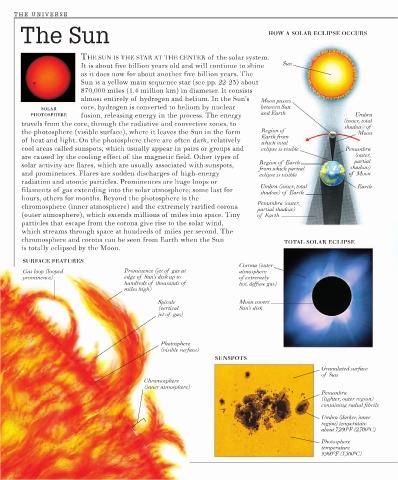
       The Sun                                                              HOW A SOLAR ECLIPSE OCCURS


                       THE SUN IS THE STAR AT THE CENTER of the solar system.
                                                                                Sun
                       It is about five billion years old and will continue to shine
                       as it does now for about another five billion years. The
                       Sun is a yellow main sequence star (see pp. 22-23) about
                       870,000 miles (1.4 million km) in diameter. It consists
                       almost entirely of hydrogen and helium. In the Sun’s   Moon passes
                       core, hydrogen is converted to helium by nuclear   between Sun
            SOLAR
                                                                         and Earth
          PHOTOSPHERE  fusion, releasing energy in the process. The energy                          Umbra
                                                                                                (inner, total
       travels from the core, through the radiative and convective zones, to                     shadow) of
       the photosphere (visible surface), where it leaves the Sun in the form    Region of          Moon
                                                                          Earth from
       of heat and light. On the photosphere there are often dark, relatively   which total
       cool areas called sunspots, which usually appear in pairs or groups and   eclipse is visible  Penumbra
       are caused by the cooling effect of the magnetic field. Other types of                       (outer,
                                                                         Region of  Earth          partial
       solar activity are flares, which are usually associated with sunspots,
                                                                         from which partial       shadow)
       and prominences. Flares are sudden discharges of high-energy      eclipse is visible       of  Moon
       radiation and atomic particles. Prominences are huge loops or
                                                                         Umbra (inner, total        Earth
       filaments of gas extending into the solar atmosphere; some last for   shadow) of  Earth
       hours, others for months. Beyond the photosphere is the
                                                                        Penumbra (outer,
       chromosphere (inner atmosphere) and the extremely rarified corona   partial shadow)
       (outer atmosphere), which extends millions of miles into space. Tiny   of  Earth
       particles that escape from the corona give rise to the solar wind,
       which streams through space at hundreds of miles per second. The
       chromosphere and corona can be seen from Earth when the Sun
                                                                                TOTAL SOLAR ECLIPSE
       is totally eclipsed by the Moon.
       SURFACE FEATURES
                                                                   Corona (outer
       Gas loop (looped             Prominence (jet of  gas at     atmosphere
       prominence)                  edge of  Sun’s disk up to      of extremely
                                    hundreds of  thousands of      hot, diffuse gas)
                                    miles high)
                                             Spicule               Moon covers
                                             (vertical             Sun’s disk
                                             jet of  gas)


                                              Photosphere
                                              (visible surface)
                                                             SUNSPOTS
                                                                                          Granulated surface
                                                                                          of  Sun
                                         Chromosphere
                                         (inner atmosphere)
                                                                                          Penumbra
                                                                                          (lighter, outer region)
                                                                                          containing radial fibrils
                                                                                          Umbra (darker, inner
                                                                                          region) temperature
                                                                                          about 7,200°F (2,700°C)
                                                                                          Photosphere
                                                                                          temperature
                                                                                          9,900°F (5,500°C)

