


Page 36 - Ultimate Visual Dictionary (DK)
P. 36
THE UNIVERSE

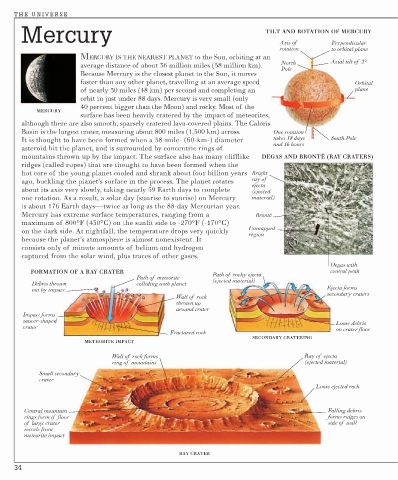
       Mercury                                                             TILT AND ROTATION OF MERCURY
                                                                               Axis of
                                                                                             to orbital plane
                                                                               rotation      Perpendicular
                       MERCURY IS THE NEAREST PLANET to the Sun, orbiting at an              Axial tilt of  2°
                       average distance of about 36 million miles (58 million km).   North
                                                                               Pole
                       Because Mercury is the closest planet to the Sun, it moves
                       faster than any other planet, travelling at an average speed                 Orbital
                       of nearly 30 miles (48 km) per second and completing an                      plane
                       orbit in just under 88 days. Mercury is very small (only
                       40 percent bigger than the Moon) and rocky. Most of the
           MERCURY
                       surface has been heavily cratered by the impact of meteorites,
       although there are also smooth, sparsely cratered lava-covered plains. The Caloris
       Basin is the largest crater, measuring about 800 miles (1,300 km) across.    One rotation
       It is thought to have been formed when a 38-mile- (60-km-) diameter    takes 58 days   South Pole
                                                                             and 16 hours
       asteroid hit the planet, and is surrounded by concentric rings of
       mountains thrown up by the impact. The surface also has many clifflike   DEGAS AND BRONTË (RAY CRATERS)
       ridges (called rupes) that are thought to have been formed when the
       hot core of the young planet cooled and shrank about four billion years  Bright
       ago, buckling the planet’s surface in the process. The planet rotates   ray of
                                                                       ejecta
       about its axis very slowly, taking nearly 59 Earth days to complete    (ejected
       one rotation. As a result, a solar day (sunrise to sunrise) on Mercury   material)
       is about 176 Earth days—twice as long as the 88-day Mercurian year.
       Mercury has extreme surface temperatures, ranging from a         Brontë
       maximum of 800°F (430°C) on the sunlit side to -270°F (-170°C)
                                                                      Unmapped
       on the dark side. At nightfall, the temperature drops very quickly
                                                                      region
       because the planet’s atmosphere is almost nonexistent. It
       consists only of minute amounts of helium and hydrogen
       captured from the solar wind, plus traces of other gases.
                                                                                             Degas with
          FORMATION OF A RAY CRATER                         Path of  rocky ejecta            central peak
                                       Path of  meteorite
          Debris thrown                colliding with planet  (ejected material)
          out by impact                                                                     Ejecta forms
                                                                                            secondary craters
                                                  Wall of  rock
                                                  thrown up
                                                  around crater
       Impact forms
       saucer-shaped                                                                          Loose debris
       crater                                                                                 on crater floor
                                                Fractured rock
                                                                       SECONDARY CRATERING
                         METEORITE IMPACT
                                Wall of  rock forms                                   Ray of  ejecta
                                ring of  mountains                                    (ejected material)
            Small secondary
            crater
                                                                                         Loose ejected rock


        Central mountain                                                                    Falling debris
        rings form if  floor                                                                forms ridges on
        of  large crater                                                                    side of  wall
        recoils from
        meteorite impact

                                                   RAY CRATER

     34

