


Page 30 - Ultimate Visual Dictionary (DK)
P. 30
THE UNIVERSE

       Neutron stars


       and black holes


       NEUTRON STARS AND BLACK HOLES form from the stellar cores that remain after
       stars have exploded as supernovae (see pp. 26-27). If the remaining core is
       between about one and a half and three solar masses, it contracts to form a
       neutron star. If the remaining core is greater than about three solar masses,
       it contracts to form a black hole. Neutron stars are typically only about
       6 miles (10 km) in diameter and consist almost entirely of subatomic
       particles called neutrons. Such stars are so dense that a teaspoonful
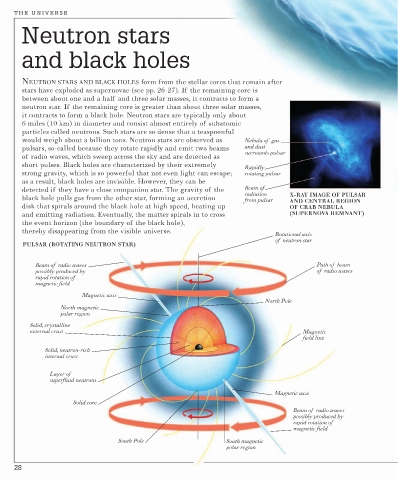
       would weigh about a billion tons. Neutron stars are observed as   Nebula of  gas
       pulsars, so-called because they rotate rapidly and emit two beams   and dust
                                                                     surrounds pulsar
       of radio waves, which sweep across the sky and are detected as
       short pulses. Black holes are characterized by their extremely   Rapidly
       strong gravity, which is so powerful that not even light can escape;   rotating pulsar
       as a result, black holes are invisible. However, they can be
       detected if they have a close companion star. The gravity of the   Beam of
                                                                     radiation    X-RAY IMAGE OF PULSAR
       black hole pulls gas from the other star, forming an accretion   from pulsar  AND CENTRAL REGION
       disk that spirals around the black hole at high speed, heating up          OF CRAB NEBULA
       and emitting radiation. Eventually, the matter spirals in to cross         (SUPERNOVA REMNANT)
       the event horizon (the boundary of the black hole),
       thereby disappearing from the visible universe.
                                                                             Rotational axis
                                                                             of  neutron star
       PULSAR (ROTATING NEUTRON STAR)

           Beam of  radio waves                                                          Path of  beam
           possibly produced by                                                          of  radio waves
           rapid rotation of
           magnetic field
                        Magnetic axis
                                                                           North Pole
                  North magnetic
                  polar region
         Solid, crystalline
         external crust                                                              Magnetic
                                                                                     field line
             Solid, neutron-rich
             internal crust

               Layer of
               superfluid neutrons
                                                                             Magnetic axis
                     Solid core
                                                                                  Beam of  radio waves
                                                                                  possibly produced by
                                                                                  rapid rotation of
                                                                                  magnetic field
                                  South Pole                    South magnetic
                                                                polar region


     28

