


Page 40 - Ultimate Visual Dictionary (DK)
P. 40
THE UNIVERSE

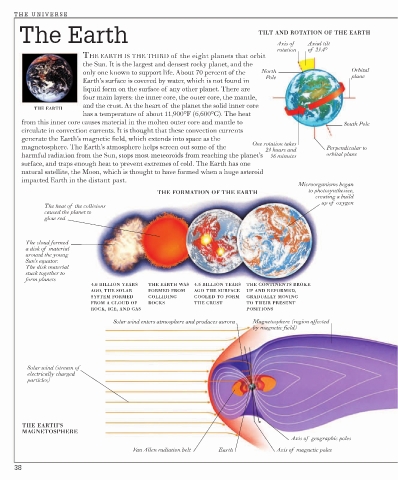
      The Earth                                                          TILT AND ROTATION OF THE EARTH
                                                                              Axis of    Axial tilt
                                                                              rotation  of  23.4°
                        THE EARTH IS THE THIRD of the eight planets that orbit
                        the Sun. It is the largest and densest rocky planet, and the
                        only one known to support life. About 70 percent of the   North            Orbital
                                                                           Pole                    plane
                        Earth’s surface is covered by water, which is not found in
                        liquid form on the surface of any other planet. There are
                        four main layers: the inner core, the outer core, the mantle,
                        and the crust. At the heart of the planet the solid inner core
           THE EARTH
                        has a temperature of about 11,900°F (6,600°C). The heat
       from this inner core causes material in the molten outer core and mantle to               South Pole
       circulate in convection currents. It is thought that these convection currents
       generate the Earth’s magnetic field, which extends into space as the
                                                                       One rotation takes
       magnetosphere. The Earth’s atmosphere helps screen out some of the                   Perpendicular to
                                                                           23 hours and
                                                                                            orbital plane
       harmful radiation from the Sun, stops most meteoroids from reaching the planet’s  56 minutes
       surface, and traps enough heat to prevent extremes of cold. The Earth has one
       natural satellite, the Moon, which is thought to have formed when a huge asteroid
       impacted Earth in the distant past.
                                                                                    Microorganisms began
                                             THE FORMATION OF THE EARTH                to photosynthesize,
                                                                                         creating a build
                                                                                          up of  oxygen
             The heat of  the collisions
             caused the planet to
             glow red

        The cloud formed
        a disk of  material
        around the young
        Sun’s equator.
        The disk material
        stuck together to
        form planets
                          4.6 BILLION YEARS   THE EARTH WAS  4.5 BILLION YEARS  THE CONTINENTS BROKE
                          AGO, THE SOLAR   FORMED FROM   AGO THE SURFACE   UP AND REFORMED,
                          SYSTEM FORMED   COLLIDING    COOLED TO FORM   GRADUALLY MOVING
                          FROM A CLOUD OF   ROCKS      THE CRUST     TO THEIR PRESENT
                          ROCK, ICE, AND GAS                         POSITIONS
                                 Solar wind enters atmosphere and produces aurora  Magnetosphere (region affected
                                                                       by magnetic field)


         Solar wind (stream of
         electrically charged
         particles)


       THE EARTH’S
       MAGNETOSPHERE
                                                                                  Axis of  geographic poles
                                      Van Allen radiation belt  Earth         Axis of  magnetic poles

     38

