


Page 48 - Ultimate Visual Dictionary (DK)
P. 48
THE UNIVERSE

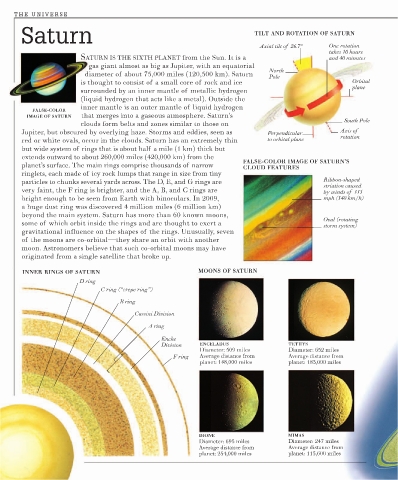
       Saturn                                                           TILT AND ROTATION OF SATURN

                                                                         Axial tilt of  26.7°  One rotation
                                                                                            takes 10 hours
                       SATURN IS THE SIXTH PLANET from the Sun. It is a                     and 40 minutes
                          gas giant almost as big as Jupiter, with an equatorial
                                                                            North
                         diameter of about 75,000 miles (120,500 km). Saturn
                                                                            Pole
                       is thought to consist of a small core of rock and ice                       Orbital
                                                                                                   plane
                       surrounded by an inner mantle of metallic hydrogen
                       (liquid hydrogen that acts like a metal). Outside the
                       inner mantle is an outer mantle of liquid hydrogen
          FALSE-COLOR
        IMAGE OF SATURN  that merges into a gaseous atmosphere. Saturn’s
                                                                                                 South Pole
                       clouds form belts and zones similar to those on
       Jupiter, but obscured by overlying haze. Storms and eddies, seen as    Perpendicular     Axis of
                                                                                                rotation
       red or white ovals, occur in the clouds. Saturn has an extremely thin   to orbital plane
       but wide system of rings that is about half a mile (1 km) thick but
       extends outward to about 260,000 miles (420,000 km) from the
                                                                     FALSE-COLOR IMAGE OF SATURN’S
       planet’s surface. The main rings comprise thousands of narrow
                                                                     CLOUD FEATURES
       ringlets, each made of icy rock lumps that range in size from tiny
       particles to chunks several yards across. The D, E, and G rings are                 Ribbon-shaped
                                                                                           striation caused
       very faint, the F ring is brighter, and the A, B, and C rings are                   by winds of  335
       bright enough to be seen from Earth with binoculars. In 2009,                       mph (540 km/h)
       a huge dust ring was discovered 4 million miles (6 million km)
       beyond the main system. Saturn has more than 60 known moons,
                                                                                           Oval (rotating
       some of which orbit inside the rings and are thought to exert a                     storm system)
       gravitational influence on the shapes of the rings. Unusually, seven
       of the moons are co-orbital—they share an orbit with another
       moon. Astronomers believe that such co-orbital moons may have
       originated from a single satellite that broke up.

       INNER RINGS OF SATURN                            MOONS OF SATURN
                       D ring
                             C ring (“crepe ring”)
                                  B ring
                                      Cassini Division
                                          A ring
                                              Encke
                                              Division   ENCELADUS               TETHYS
                                                         Diameter: 509 miles     Diameter: 652 miles
                                                 F ring  Average distance from   Average distance from
                                                         planet: 148,000 miles   planet: 183,000 miles


                                                        DIONE                    MIMAS
                                                        Diameter: 695 miles      Diameter: 247 miles
                                                        Average distance from    Average distance from
                                                        planet: 254,000 miles    planet: 115,600 miles

